Palantir’s Interview Process & Questions
The info below is based on conversations with Palantir engineers.
Palantir's Interview Process for Software Engineers: 4 Steps
Mid to senior-level engineers interviewing at Palantir can expect the following process:
- Recruiter call (30 minutes)
- Technical phone screen (1 hour)
- Onsite (3 hour)
- Hiring manager screen (1 hour)
General tips:
- They put a huge emphasis on cultural fit. Behavioral questions will be asked in every interview. Come prepared!
- Palantir believes in protecting civil liberties and rights. They look for people who are comfortable discussing these topics.
- It’s a mix of standard LeetCode-style questions and very non-standard questions. LeetCode prep isn’t going to be enough here.
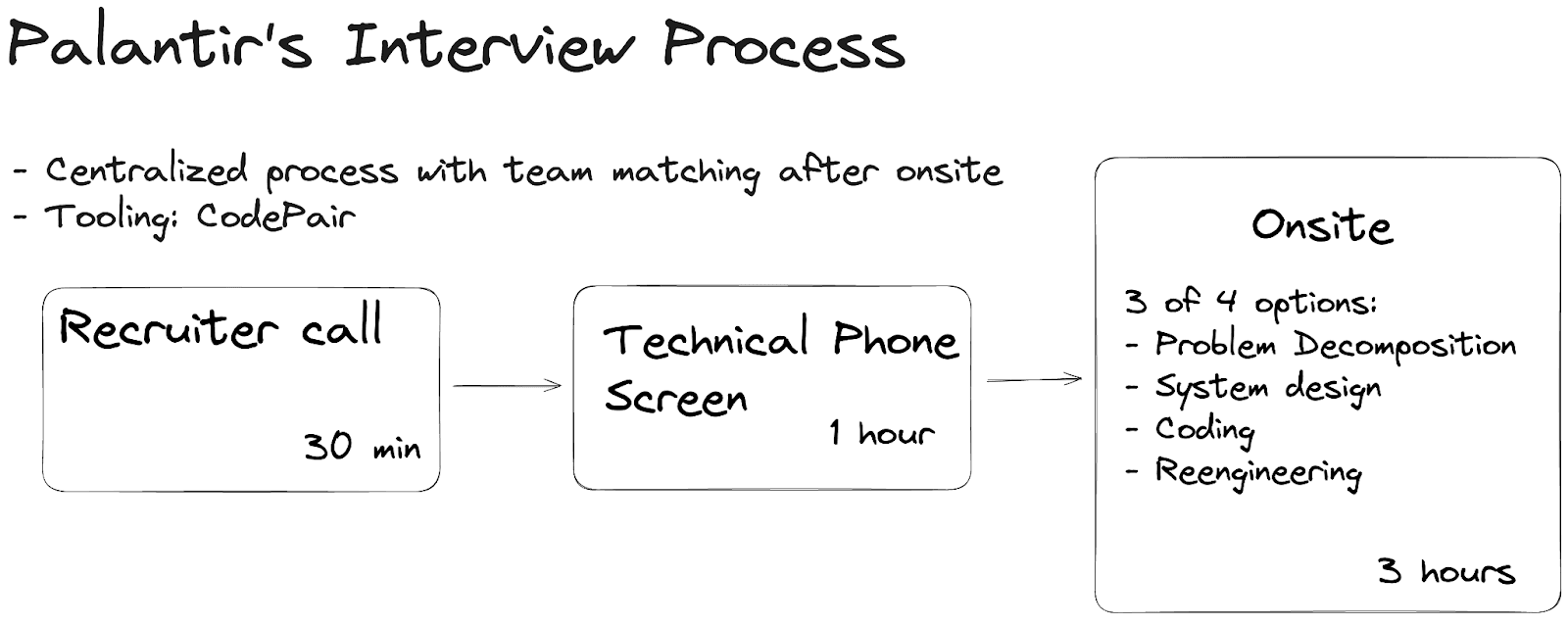
At Palantir, you apply for a catch-all backend or full stack role and team matching will happen later in the process. The process doesn’t vary much between roles although there are some variations for different levels of seniority. The recruiter might adjust the track you are on very slightly through the process but you’re more likely to do team matching after the onsite.
The entire process takes and 3-4 weeks but it’s possible to expedite things, especially with other offers in hand.
AI Usage
AI use in Palantir interviews is strictly prohibited.
Step 1: Recruiter Call
Palantir’s recruiter call lasts 30 minutes, and it’s an important step. They filter out more candidates than most companies do at this stage from what we hear. They are looking for your motivations to join the company, so come to this call prepared to discuss why you want to be there in detail. It helps to have a compelling story as to what drew you to Palantir. You might get asked about your favorite, and least favorite past projects, as well as what you want to work on moving forward. They look for any red flags indicating you won’t be there long-term. An engineer who knows their process very well says:
“Surface-level motivations to join the company won’t get you far and they will reject strong technical candidates if they don’t seem like a good cultural fit!”
It’s really important, at this stage, to not reveal your salary expectations or where you are in the process with other companies. We’ve written a detailed post about salary negotiation that lays out exactly what to say if recruiters pressure you to name the first number.
Step 2: Technical Phone Screen
Palantir’s technical phone screen lasts about an hour and happens in CodePair. This interview will feature algorithms and data structures but, the difference is that it won’t be purely technical and the algorithm you are solving will be put in the context of something you are building for an end-user. You’ll get asked to solve a problem in one half of the interview and behavioral questions in the other half. We will cover what we know of their question style in the section called “Types of Interview Questions to Expect at Palantir” below.
Step 3: Onsite
Palantir has 4 types of interviews they give most engineers during the onsite loop. You will only get 3 of the 4, but we will describe each here.
Every onsite interview will have 20 minutes of behavioral questions!
- Problem decomposition (1 hour). This is one of the options that you will almost definitely get. It’s really important and non-standard. For more detail about the kinds of questions to expect, see the Problem decomposition section below.
- System design (1 hour). This will be conducted in CodePair using the whiteboard functionality. For more detail about the kinds of questions to expect, see the System Design section below.
- Re-engineering (1 hour). You’ll be given a piece of code in CodePair and asked to review it for bugs. For more detail about the kinds of questions to expect, see the Re-engineering section below.
- Coding (1 hour). This will be similar to the technical screen before the onsite, and is conducted in CodePair. For more detail about the kinds of questions to expect, see the Coding section below.
Step 4: Hiring Manager Interview
This interview will be a repeat of one of the onsite interviews. They look for red flags during the onsite and like to revisit any area they felt wasn’t up to scratch. It might not even be the technical piece they want to review! Again, the behavioral questions are very important.
Types of Interview Questions to Expect at Palantir
We can’t stress enough how embedded behavioral questions are at Palantir. As there is no behavioral interview during the onsite, they like to assess your motivations, cultural fit, and ability to work collaboratively all through the process. Come prepared with STAR-style answers, stories about why you want to work for Palantir, and ways you’ve thought about the end-user experience in other roles. If you propose a solution, talk about how it could be improved or modified for the users' benefit. You will also be asked about what projects you’ve enjoyed and not enjoyed. They want to know you’re OK working on all sorts of projects, not just glamorous ones.
Coding
The coding problems posed before are during the onsite will reflect the type of work you will be doing at Palantir, i.e., building products for end-users. So, while the core technical question might look like a standard LeetCode-style problem, it will be put in the context of a larger solution for an end-user. You’ll have to solve the problem but also consider and discuss its impact on the whole system, and how it will be used by the user. You’ll need to ask a lot of clarifying questions as it will be under-defined at first. Just keep thinking about the end-user and what trade-offs you will have to make in order to make the user experience positive. Maybe your solution is memory intensive, or maybe it's more runtime complexity intensive - think about and discuss improvements you could make to help the user in future iterations. They value user-centric thinking and empathy in finding solutions over algorithmic complexity. Think about how the user will use the code and how it could be improved, e.g., maybe you could implement caching so the user has a better experience each time they use the solution.
A user who is very familiar with the Palantir interview process had this to say:
“What strategies do you consider for enhancing performance beyond just the code you’re currently working on? Consider aspects such as caching and pre-computation to improve efficiency. Initially, your solution may not be the fastest, but implementing these strategies could significantly speed up subsequent operations.
"Expect the problem to be intentionally vague. It’s important to anticipate and address any ambiguous scenarios, demonstrate caution regarding potential issues, and safeguard the system from malicious users.”
Regardless of what question you get, they’ll ask about decision-making, time and space complexity, etc. They want to know why you would approach a problem in a certain way, and they look for things that might cause issues with client integrations, etc.
Below are the technical topics you’re likely to encounter in Palantir interviews. To compile this list, we did two things. First, we spoke to some current and former Palantir engineers. Then we cross-referenced all the anecdotes we heard with Glassdoor data AND our own data-set of mock interviews:
System Design
Again, this will be an industry standard round bar the added behavioral aspects. Our system design guide has been called “excellent preparation” by someone very familiar with Palantir’s interview.
Check out our guide to system design interviews to help you prepare.
Re-engineering
In this interview, you will be given a bunch of code in CodePair and asked to review it for bugs. You’ll be told how the system is supposed to work and that the output is wrong when you run the code. It will be about 500-100 lines of code, and it’s really important not to get lost in the first issue you see. Review everything from top to bottom as they will probably put in red herrings to distract you!
Problem Decomposition
This is probably the most important technical round you will face. It’s a non-standard interview where you will be asked to solve a high-level, real-world technical problem, with a real focus on thinking about the end-user. You won’t have to write code outside of maybe some pseudocode.
The problem might be something like:
"How would you design a technology to help elderly people with poor vision who want to cook for themselves?"
It will be focused on an individual or an organization. Your goal is to come up with how to use technology to solve this problem. A lot of the focus here is on breaking the problem down into its component parts so you can tackle it. You’ll need to think about the time your solution will take, as well as how the respective parts of the solution might be built by different teams.
There will be two parts:
- Ideation: Break the problem down into its respective pieces and propose a solution to each. Agree on the solution with your interviewer.
- Execution: How you would design the solution at a high-level. This is more like system design. You won’t need to go too deep technically, e.g., you won’t need to provide detail on the type of database you would use, but you might discuss the type of data / schema you’d need to solve the problem.
The important thing here is, as with other rounds, to focus on the end-user. Think about how your solution would be used. Discuss ways to make it better. You’re being asked to display both your ability to problem-solve and your ability to empathize with users/clients.
Hiring Manager Interview
After the onsite, the interview panel meets with a hiring manager to discuss your performance. If you pass, they’ll match you with a team that needs your skillset. From there, you’ll interview again with the hiring manager for that team. This will be your final round and it will repeat one of the above rounds. If they see a red flag around motivation or culture fit, they’ll be looking to test you on it again.
How Palantir Makes Hiring Decisions
The final decision rests with the hiring manager you interview with last from what we can tell.
See something inaccurate? Please fill out this form, and tell us about it.

About interviewing.io
interviewing.io is a mock interview practice platform. We've hosted over 100K mock interviews, conducted by senior engineers from FAANG & other top companies. We've drawn on data from these interviews to bring you the best interview prep resource on the web.