Anthropic’s Interview Process & Questions
The info below is based on conversations with Anthropic engineers in 2026.
Anthropic's Interview Process for Software Engineers: 3 Steps
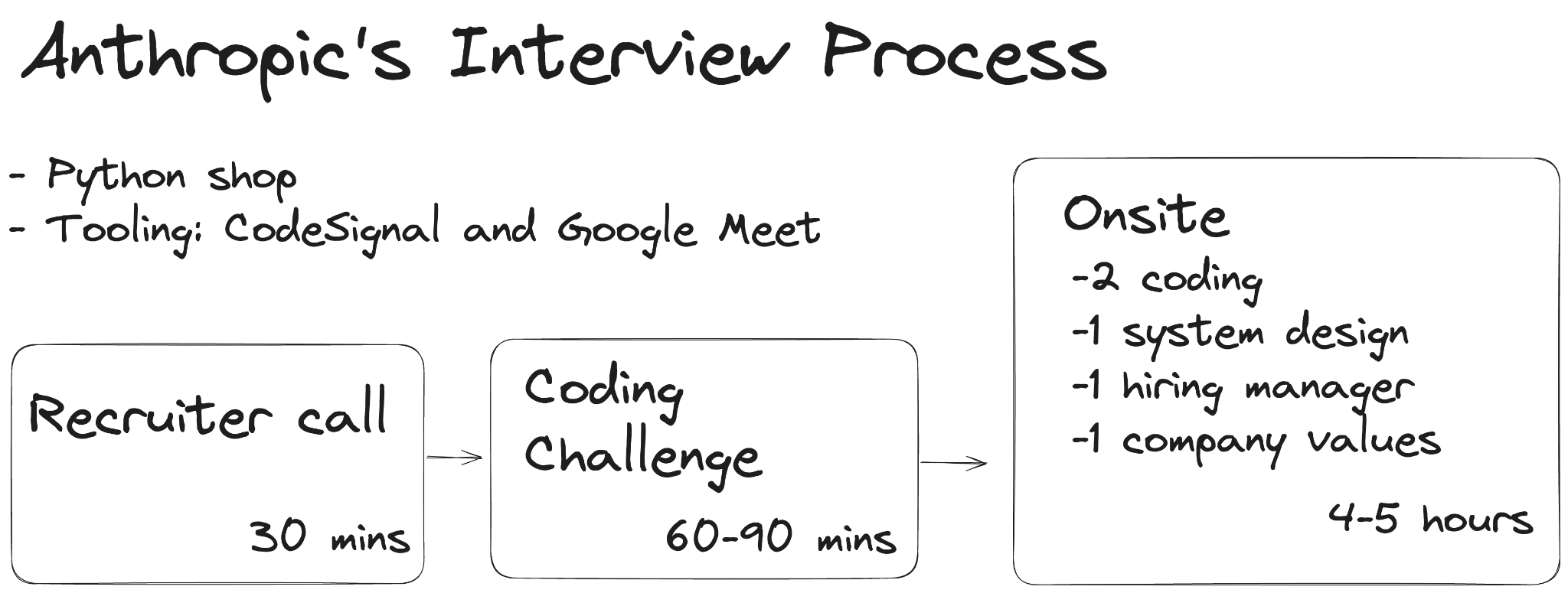
Mid to senior-level engineers interviewing at Anthropic can expect the following process:
- Recruiter call (30 minutes)
- Coding challenge (if you got referred in, they might skip this step) (60-90 mins)
- Onsite (4-5 hours)
Anthropic has product engineering teams plus a number of research and infrastructure teams. Team matching happens after the onsite.
General tips:
- The recruiter screen is non-trivial. It's not a formality, and you can fail it. Mission alignment is tested here, as well as later in the process during the company values round.
- For the Hiring Manager call, have a strong project ready to walk through in depth. The HM call varies a lot by role, but this is the one constant.
- Brush up on system design.
- Concurrency and multithreading come up across multiple rounds. Make sure you're comfortable with both before you go in.
- The values/culture round is where most candidates fail, per Anthropic recruiters, so weight your prep accordingly.
- Though Anthropic’s coding questions are algorithmic, they tend to be more practical than the verbatim LeetCode questions that many companies use.
- Use a larger monitor for your coding challenge – time is of the essence, and a laptop has limited real estate to view and write code
- The process moves fast, especially if you have competing offers. Don't expect the buffer time you'd get at Google or Meta.
- They use Python, and you’ll need to be comfortable with it.
- Note that the Hiring Manager call, if it involves code review, may cover multiple languages
The entire process takes about 3-4 weeks and is generally well-organized, although they are hiring quickly and we’ve been told that the volume they are dealing with can lead to slower response times or friction throughout the process. That said, they hold themselves to a high bar and try to make it a good experience. From one of our users who recently interviewed with Anthropic:
This felt so easy and thoughtful compared to all the other companies I interviewed with. They have their shit together. Efficient, thoughtful, won’t waste your time. They move faster than expected!
Note that the bar is extremely high, and the interviews are genuinely hard to prepare for, particularly the company values round.
AI Usage
AI use in Anthropic interviews is strictly prohibited. They have laid out clear guidelines for when AI is allowed during the entire hiring process, and it’s not permitted at all in live interviews, unless they explicitly say otherwise.
Step 1: Recruiter Call
Anthropic's recruiter call lasts 30 minutes, and it's more important than it might seem. Technically strong and impressive candidates fail here because they haven't done the reading and can't speak to why they want to work at Anthropic specifically. Come prepared to articulate why this company, not just “why AI”. They’ll ask you about your previous experience, your understanding of Anthropic’s value proposition, and what you’re looking for moving forward. They’ll also explain that they are a B Corp and cover what that means.
It’s really important, at this stage, to not reveal your salary expectations or where you are in the process with other companies. We’ve written a detailed post about salary negotiation that lays out exactly what to say if recruiters pressure you to name the first number.
Step 2: Coding Challenge
We’ve heard that this can be done live or asynchronously. Most of the people we spoke to took a 90-minute take-home assessment in CodeSignal, but Anthropic's website says you might get a 60-minute live assessment, so it seems to be role-dependent. It won’t be a LeetCode-style problem, but will still be pretty straightforward. You will be asked to complete a task that gets progressively more complex. One challenge we heard about was to implement a bank with multiple transaction types. We’ve heard that candidates tend to run out of time in this round, so manage your time carefully. (Note that the bank transaction system question has been widely circulated and spotted on Blind/YouTube. Anthropic still uses it, but be aware that interviewers may be alert to over-rehearsed solutions.)
One engineer who took the take-home assessment told us that:
The screening was conducted on Code Signal, consisting of a general specification and a black-box evaluator. There were four levels. The spec would get more complicated at each level, and your code had to pass all the tests at one level to get to the next level. All in two hours.
The verbal spec was straightforward. No special algorithmic knowledge was needed. But the spec interpretation could only be obtained by repeatedly running your code to see what test cases failed.
Makes me think the folks who go to the next level are probably good at reading ambiguous specs and trying out theories against black-box graders.
Get coached by an Anthropic engineer
If you’re serious about landing Anthropic, generic prep won’t cut it. Work 1:1 with an Anthropic engineer who understands exactly how their interviews are run — what they’re actually looking for, where candidates slip up, and how to stand out in each round.
Step 3: Onsite
The final round typically consists of five sessions, though composition varies by role, and some roles may have the hiring manager call before the onsite.
- Hiring manager call (1 hour). For more detail about the kinds of questions to expect, see the Hiring manager call section below.
- Coding (1 hour). This interview will be conducted in CodeSignal. For more detail about the kinds of questions to expect, see the Coding section below.
- System design (1 hour). This interview will be conducted in a shared Google Doc. For more detail about the kinds of questions to expect, see the System Design section below.
- Second coding (role-specific)(1 hour). For more detail about the kinds of questions to expect, see the Coding section below.
- Company values (1 hour). For more info about what questions to expect, see the Company Values section below.
Types of Interview Questions to Expect at Anthropic
Hiring Manager Call
The main thing being tested here is your ability to talk about past work in depth. Have a strong project ready to walk through, and expect to be pushed on implementation details, the decisions you made, tradeoffs you considered, and what you'd do differently now.
Beyond that, the format varies quite a bit depending on the hiring manager. Some candidates reported a more technical call that included reviewing code examples in different programming languages, detecting issues, and identifying what the code does. Others described a more conversational discussion of past projects or the requirements of the role.
Note that for some candidates, this is a standalone step before the onsite. For others, it happens as one of the sessions within the final round itself.
Coding
Anthropic's coding style is first-principles and build-from-scratch. Expect to defend your complexity choices, handle edge cases under pressure, and implement data structures from scratch after you've already solved a problem cleanly with a standard library. Time pressure is lower than at Meta or OpenAI, and you write less code, but the reasoning behind every decision is front and center.
Concurrency is a recurring theme across rounds, not isolated to one question.
Most coding rounds are carried out in a shared Python environment, so you’ll need to be comfortable with the syntax and standard library. Note that you do not have to know anything about machine learning or have research experience to interview with Anthropic as a software engineer.
Below are the technical topics you’re likely to encounter in Anthropic interviews. To compile this list, we did two things. First, we spoke to some current and former Anthropic engineers. Then we cross-referenced all the anecdotes we heard with Glassdoor data AND our own data-set of mock interviews:
- Data mutation
- Concurrency
- Multithreading
And here are technical topics that you’re likely to find at other companies as well (for these we’ve created detailed write-ups of their own):
System Design
Candidates have consistently flagged this as one of the most demanding rounds so come prepared.
Expect questions that are directly related to problems Anthropic actually works on: designing an API for serving large language models efficiently, covering request batching, queuing, and how to think about GPU utilization under variable load. For infrastructure or ML-adjacent roles, familiarity with LLM inference concepts will serve you well. You might be asked to:
- Design a system that enables a GPT to handle multiple questions in a single thread
- Design a Claude chat service
- Design a banking app
One candidate who recently went through the process told us:
Don't worry about memory constraints, and focus more on interesting architectural considerations.
Check out our guide to system design interviews to help you prepare.
Company Values
This is a standalone round with non-technical interviewers, and it's where many candidates fail. Candidates we've spoken to flagged it as the hardest part of the process to prepare for, and that it’s quite challenging compared to these types of interviews at other companies, not because the questions are difficult, but because the format is unlike anything they had encountered elsewhere. Multiple interviewees described it as feeling closer to a therapy session than a job interview: deeply personal, emotionally probing, and conversational.
What they're actually testing: Whether you'll hold your values under real pressure, not whether you have the right opinions about AI. They don't want enthusiasm or alignment-signaling. They actively look for skepticism and pushback. If asked for your honest feedback on Anthropic's mission, give one. Thoughtful disagreement lands better than agreement.
The style of questions: Expect a mix of reflective and hypothetical questions. The reflective ones will ask you to draw on real experiences: moments where your values were tested, where you pushed back on something, where you changed your mind about something you'd previously believed strongly. The hypotheticals will put you in novel ethical situations with no clean answer, often ones that probe how you'd apply Anthropic's values to problems you've never rehearsed. Follow-up questions will consistently focus on emotions rather than just outcomes: how you felt at the time, and how you feel about it now.
How to prepare:
- Do the research.
- Before anything else, get to grips with this content:
- Machines of Loving Grace (Dario Amodei, 2024), the optimistic case for what powerful AI could do if it goes right
- The Adolescence of Technology (Dario Amodei, Jan 2026), on risks and why scrutiny of AI companies matters
- Core Views on AI Safety (Anthropic, 2023), the clearest statement of their safety-first thesis.
- Then watch at least one long-form conversation with Dario Amodei (Anthropic’s CEO). The Dwarkesh, and Lex Fridman podcasts will give you insight into the founding philosophy in Dario's own words The goal is to internalize the world view, not parrot talking points.
- Before anything else, get to grips with this content:
- Use deep/serious examples. When drawing on past experience, reach for moments with real ethical weight, situations where something genuinely uncomfortable was at stake. Trivial examples won't land.
- Prepare to talk about your emotions, not just events. Be ready to talk about how you felt about what was happening, not just what was happening. Build that into your examples before you go in. What you did is less interesting to them than how you experienced it.
- Don't over-engineer your answers. The instinct to structure everything like an engineer works against you here. Be a person, not a framework.
- Be skeptical, not a fanboy. Anthropic values critical thinking over enthusiasm. They want to see that you've genuinely wrestled with the implications of what they're building.
- Internalize their actual values. You'll be asked to apply them to situations you haven't rehearsed. Surface familiarity with their mission won't be enough.
Anthropic vs. OpenAI: Know the Difference
The difference in values between these two companies comes up in both the recruiter screen and the values round, and candidates who can't speak to it clearly tend to struggle. The core distinction is this: Dario Amodei and a group of colleagues left OpenAI in 2021 because they believed that scaling AI models wasn't enough on its own. Alignment and safety needed to be as important as scaling, not afterthoughts. Anthropic was, from the get-go, a company structured as a public benefit corporation, where safety isn't a constraint on the mission but rather the organizing principle of it.
You don't need to be critical of OpenAI to articulate this well. But you do need to show that you've thought about it. Candidates who say they're interested in Anthropic because they want to work on frontier AI, without being able to explain why the safety-first framing matters specifically, tend not to get through.
If you're also interviewing at OpenAI or want to understand their process too, our OpenAI interview guide covers what to expect there.
What a Non-Rehearsed Answer Sounds Like
The values round is specifically designed to surface candidates who have internalized Anthropic's worldview versus those who have memorized it. The interviewers are experienced at telling the difference. A rehearsed answer tends to be clean, complete, and emotionally flat. It covers the right topics in the right order and doesn't go anywhere unexpected. A genuine answer is messier and more personal. It might start in the wrong place, correct itself, or surface real uncertainty. It will touch on stuff that’s happened to you and have an emotional layer because the experiences being described were actually uncomfortable at the time.
In other words, don't over-prepare specific answers. Prepare the underlying material well enough that you can think out loud about it naturally. Read the pieces in the reading list above not to extract quotable positions, but to develop an actual point of view. If you find yourself disagreeing with something Dario says, that's a good sign. Bring that disagreement in. Anthropic wants to hire people who think, not people who agree.
How Anthropic Makes Hiring Decisions
Decisions are reached by consensus (everyone agrees to hire or no-hire), but in cases where consensus isn’t possible, the hiring manager has final say.
The Importance of References
Anthropic takes references seriously, and candidates should have strong ones lined up before starting the process, rather than scrambling at the offer stage. From what we've heard, reference questions probe specifically how you handled conflict and ethical friction at work, consistent with the values-first culture you'll encounter in the interview itself.
See something inaccurate? Please fill out this form, and tell us about it.

About interviewing.io
interviewing.io is a mock interview practice platform. We've hosted over 100K mock interviews, conducted by senior engineers from FAANG & other top companies. We've drawn on data from these interviews to bring you the best interview prep resource on the web.