How to get in the door at top companies: Cold outreach to hiring managers. Part 2 of 2.
In part 1 of this post, we talked about which channels are most effective for getting in the door and did an analysis of those channels along two axes: effectiveness and how much control you actually have. Here’s a quick summary.

In the quadrant above, you can see that while getting contacted by an in-house recruiter is very effective, whether you get contacted or not is largely out of your hands. The channel that maximizes both effectiveness and control is cold outreach to hiring managers (not recruiters!) “done right”. What does “done right” mean? That’s what we’ll talk about in this post (part 2 of 2). Most people do this type of outreach incorrectly. Here, we’ll get very tactical and tell you exactly what to say and do to reach out to hiring managers at the companies you’re interested in and actually get responses.
Here’s our recommended, hyper-practical approach.
Prerequisites/tooling
- Buy a month or two of LinkedIn Sales Navigator. This will run you a few hundred dollars, but it’s worth it.
- Get an account with an email discovery tool like RocketReach (an excellent email discovery tool).
- Get Streak, which lets you do mail merges in Gmail. You create an email template, with variables for everything from recipient name to long snippets of personalized text, and then you upload a CSV with all the values. The resulting emails feel personalized but get sent to hundreds of people at once.
Treat your job search like a sales funnel
If you’re an engineer, chances are you haven’t ever done sales (maybe you had a job in high school selling Cutco knives or magazines, in which case what we’re about to say will resonate). But if you do sales for any appreciable amount of time, you’ll start thinking about everything in life as a funnel.
Funnels are wide at the top and narrow at the bottom. That’s why they’re such an apt metaphor for the sales process — you do a lot of outreach, and you don’t get many responses. Of the responses you do get, relatively few will do the thing you want them to do. And even fewer will ultimately “close” (aka, buying — or, in this case, hiring).
In your engineering career, you’ve intellectually mastered many abstract concepts that are much more complex than a funnel. Despite its simplicity, however, the funnel is one of the hardest concepts to internalize emotionally, especially for people who are used to having control over outcomes. When you write code for n hours, you can expect that you will build m features.
In sales though, you do a lot of work, very little of it will pan out, and when it does pan out, it can feel almost random; an impersonal, mediocre email gets a response while your beautifully targeted email is met with deafening silence.
And then there’s rejection. When you apply to jobs online and don’t hear back, it stings, but the sting is softened by the possibility that a human never even saw your application. You’re not reaching out to people when you apply online; you’re dealing with a bureaucratic machine.
On the other hand, when you email a real human and they don’t respond, that hurts: you put yourself out there, someone made a value judgment about you, and you lost.
The good news is that, after a while, the pain lessens, and you build up some useful emotional calluses and acquire the thousand-yard stare of someone who’s been rejected a million times for a million reasons, ranging from soul-crushingly legitimate to incontrovertibly random. Sadly, there’s no shortcut. You’ve got to do the reps, you’ve got to get the rejections, and you’ve got to pick yourself up again. You get used to it, and then it doesn’t hurt as much, because experience has taught you that if you keep going, you will eventually get to a yes.
What to actually do
First, come up with a target list of companies. How to do that is out of scope for this post, but we may write about it in the future. For now, we’ll assume you have a list.
Once you have your list of companies, use LinkedIn Sales Navigator to find hiring managers at those companies (or founders or directors or VPs, as above). Below is an example query where we look for Google hiring managers.
You might think that Google is so big that sifting through all their various hiring managers will be intractable. Fortunately, you can whittle down the list to a pretty manageable size by applying some filters.
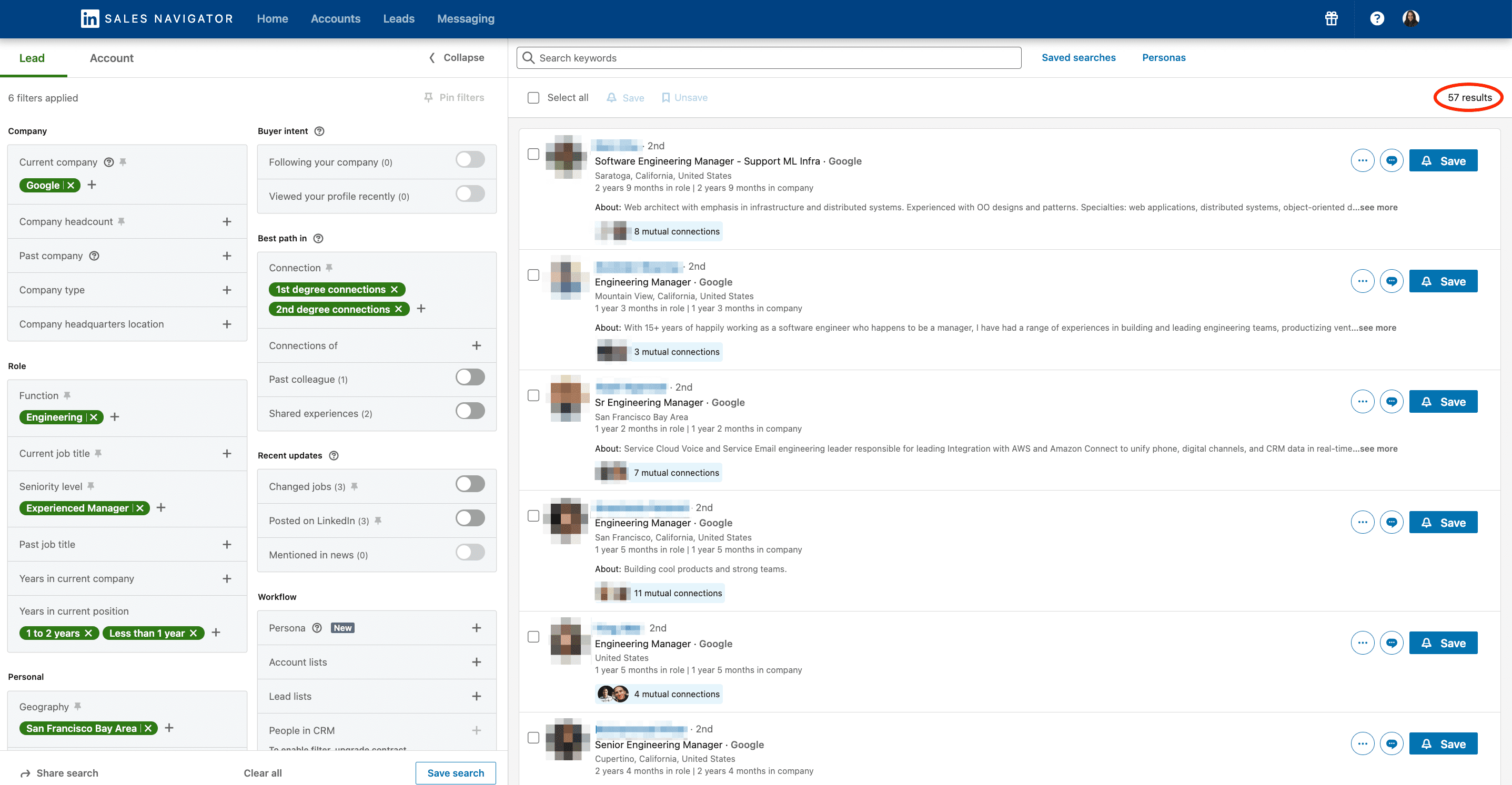
Here are our filters:
- Just targeting managers, not directors or VPs. Google is a huge organization. You want the people who are most likely to help, and they’re the ones who are struggling to hire for their teams.
- In position for less than 2 years: These are the people who are still trying to prove themselves and who are less likely to have a long-standing relationship with their recruiter to the point where they only rely on internal recruiting and overlook other sources of candidates.
- Geography: Let's focus on the places we most want to work.
- 1st- or 2nd-degree connection: This way, when they look you up, they’ll see some social proof. You can expand this to 3rd-degree connections, if needed.
Once you have your list, put their LinkedIn URLs into a spreadsheet. Then, do a pass through your targets’ profiles and see if any of them link to personal websites, social media accounts, blogs, or anything else that will help you find common ground with them. Add any useful links in your spreadsheet because we’ll be mining them when we actually write our emails.
Look up their email addresses
Once you have your list of LinkedIn URLs, use a tool like RocketReach to look up their emails.
Why not reach out on LinkedIn? While recruiters live on LinkedIn, managers generally do not. Possibly, they don't even like or check LinkedIn much. They live in their emails, so that's where you want to target them.
RocketReach is a nice tool for email discovery because 1) it takes LinkedIn URLs as inputs and 2) its email database is generally up-to-date and correct.1
If RocketReach fails or you don't wish to pay for it, you might just be able to guess their email address, as email addresses tend to follow common forms: aline@interviewing.io (my actual email address), alerner@interviewing.io, or aline.lerner@interviewing.io.
Please note that some companies have a "catch-all" domain which will not bounce back incorrect email addresses, which means you won't know if your email actually got delivered to the right person. You may want to use a tool like truelist.io to check if this is the case.
And of course, you won't always be able to find your target's work email address.2, in which case it’s acceptable to fall back to their personal email.
Write succinct, highly personalized emails
Next, compose a fairly personalized, yet short, email. All too often, candidates write a long, generic cover letter that’s obviously been sent to a ton of people. I get many emails that look like this:
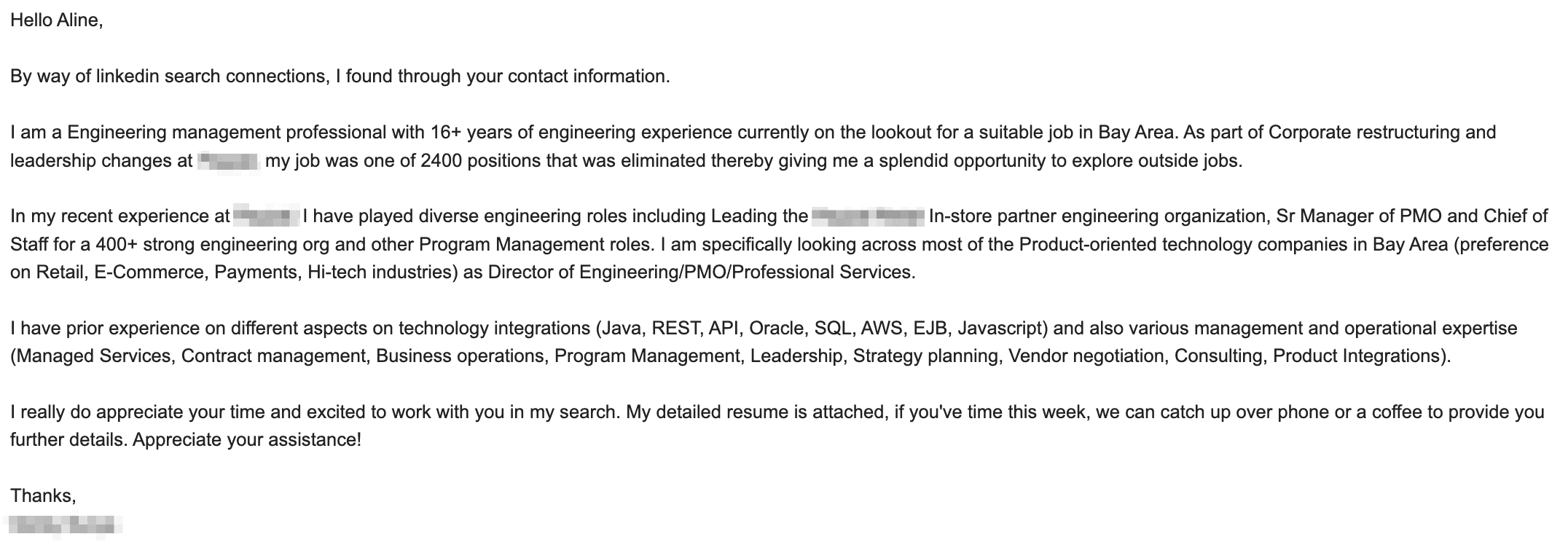
Don’t do this!
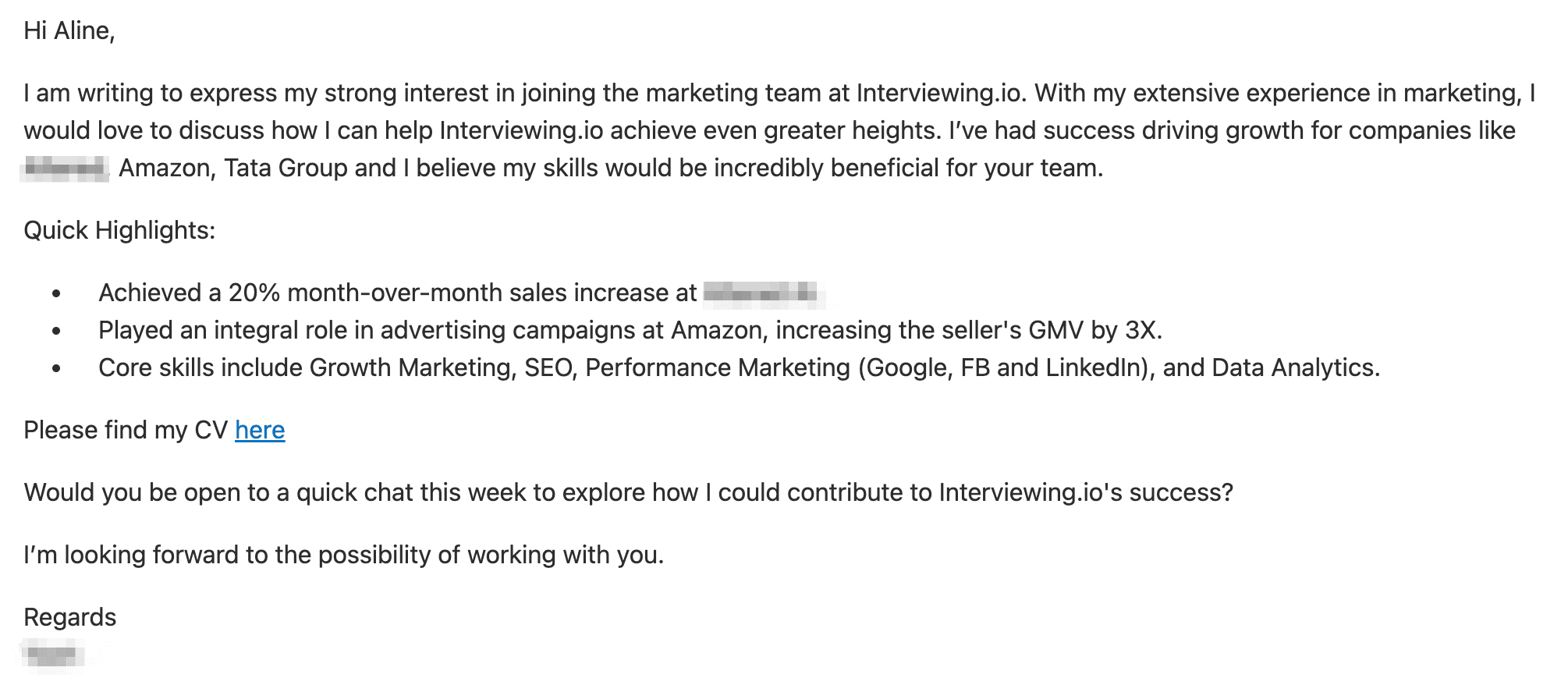
Don’t do this either! There is nothing here about why this candidate is a good fit for interviewing.io, and the bullets aren’t compelling enough on their own. Note that this particular email is from a marketer, not an engineer, but the anti-patterns are the same.
Emails like the above are impersonal, but worst of all, they have a poor signal-to-noise ratio — I want to find a reason to say yes and to invest my valuable time into this person. But they’re not giving me one, and they’re making me work for it in the process.
- Don't open email with how they found you. This is a big pet peeve of ours. I don’t care how you found me! I know I’m on LinkedIn. What I care about is why talking to you will add value for me or why you’re interesting. Use the most significant real estate in the email, the first sentence, to tell me that!
- Don't be overly formal in how you address the person. Use their first name.
- Don't get their gender wrong (e.g., referring to a woman as "sir" — you’d be surprised how often this happens).
- Don't paste in a generic cover letter. These are sure to get ignored immediately — if you’re not going to put in the effort to write to me personally, why would I put in the effort to read your email?
- Don't forget to include a link to a LinkedIn or a personal website. We don’t recommend attaching your resume, though. It can seem overly formal/somewhat presumptuous if you're trying to build rapport.
More broadly, if you want someone to go out on a limb for you, make it dead simple for them to justify expending their social/political capital on you. Hiring managers, as a rule, want to help. Make it a no-brainer for them.
There are three components to a great cold email:
- Common ground with your target
- Proof that you’re worthy of their time
- A strong call to action
Not every cold email will have (1) because you won’t always be able to find common ground with everyone — there’s simply not enough information out there about some targets to be able to craft a compelling narrative that’s highly personalized to them.
But every cold email you write should have (2). It is your job to sell yourself quickly and succinctly. You want your target to feel like they’d be an idiot to pass up the chance to talk to you.
Finding common ground
The email below is personal, succinct, and finds common ground. Not only that, but it conveniently finds common ground that benefits the candidate (a soft-spot for non-traditional candidates, like himself!).

To find common ground, reference something your target cares about. Then either show them that you care about it too or that helping you would fit into their worldview and further that cause.
As we mentioned above, finding common ground may be tough because there might not be enough information available about your target, but it’s important to do the work before you give up on this route — finding common ground is the tactic that’s going to get you the highest response rates.
Here are some examples of great ways to build common ground:
- Reference a project they worked on (maybe they wrote a blog post about it, mentioned it in a comment on Hacker News, or are a contributor to some open source project). Then…
- If possible, talk about relevant work you’ve done. It’s important not to make this connection too tenuous. If you do, this approach might backfire because they’ll start to get excited about you, only to be let down and ultimately feel tricked.
- If you do not have relevant work to share, ask a thoughtful question or two about theirs.
- Reference a controversial point of view that they hold, and affirm it in an authentic way.
- In the absence of something technical, it’s okay to reference something non-technical you've seen on their public profiles. We've seen candidates connect with strangers based on a shared love of Star Wars or Hearthstone.
We understand that you won't always be able to find common ground. But if you can, it'll help you a lot, especially if you’re light on social proof or accomplishments.
Selling yourself
Selling yourself is usually about one of two things:
- Accomplishments: What have you built or created?
- Social proof: Have you worked at a top company or attended a top school?
Some people are fortunate enough to have both, but many will have just one. That’s okay. We’ll work with what you have!
Accomplishments
What have you done that most other people haven’t? What have you done that, if you were to tell it to a stranger, would cause them to pause and think you're special or interesting?
Below are some examples:
- You’ve had a blog post about a technical topic or a personal project do well3 on Hacker News, Reddit, or social media.
- Something you built at work got some great press when your company announced its last funding round.
- You refactored a piece of code at work, and now it runs 100X faster.
- You won a company hackathon.
- You’re a core contributor to a notable open-source project.
- Something you built is being used by a number of other people.
Social proof
Social proof is more about your pedigree. If you attended a top school or worked at a company known for having a high engineering bar, you should absolutely mention it! People won't click on links or open your resume until after they're interested, so you need to get them interested right away. That is: you should spoon feed them the most impressive-sounding things about you out of the gate. This may feel strange and uncomfortable, like you’re bragging. We assure you, however, that it’s necessary to get your target’s attention. They’re not thinking you’re bragging. They’re thinking, “Is this worth my time?” Your job is to convince them that it is.
Also, don’t forget to link to your LinkedIn or personal website. Attaching a resume may feel too heavy-handed for a first conversation, as we discussed above.
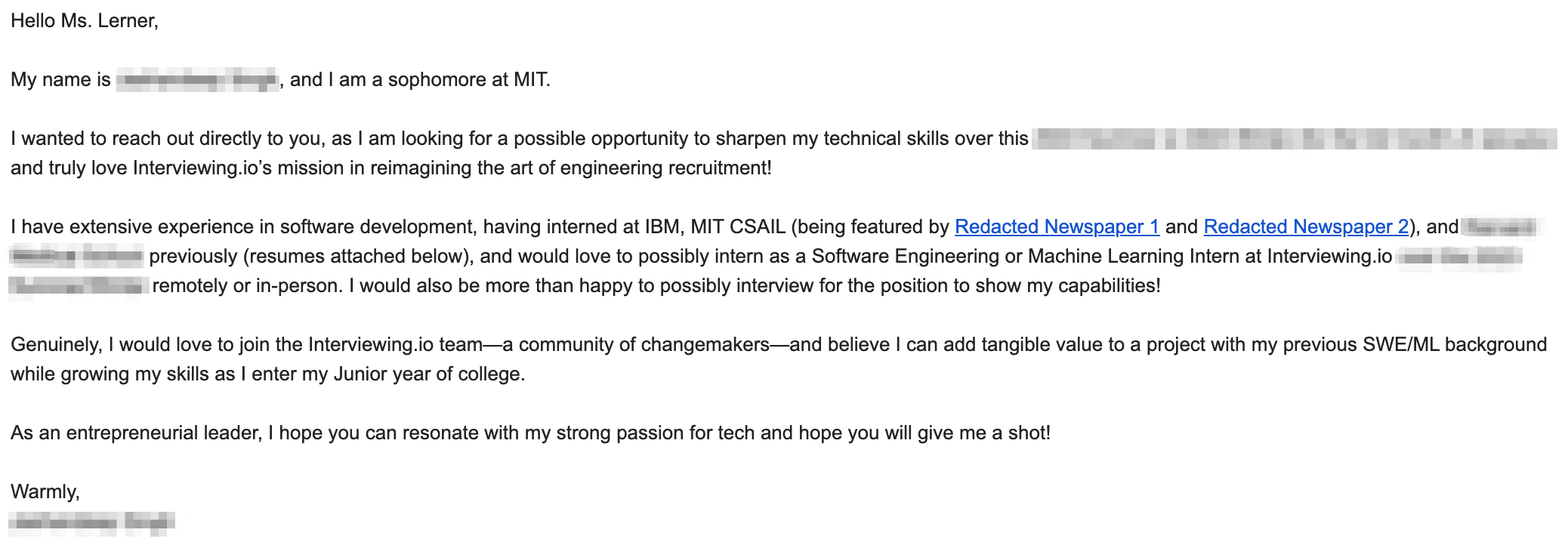
Here's an example of a prospective intern, leveraging both social proof and accomplishments, to write a compelling email. His email isn't super personalized, but he did make some effort to say that what we do at interviewing.io is important.
Formulating a strong call to action
A call to action is an invitation for the recipient to do something. You can go one of two ways with your call to action: ask for a job interview or start a conversation. Which you do should be a function of how much firepower you have in the way of social proof and accomplishments. It’s not fair, but if you can get your target’s attention with one or both of those, being bold and asking for a job interview makes sense. This approach can be effective, but it won’t work for most people… because most people don’t have enough social proof or accomplishments to justify this type of request.
If you can’t leverage social proof or accomplishments, you’re going to have to work harder and bank entirely on building common ground, which will likely take some time and effort and involve a live conversation before they’re convinced to expend their social capital on you.
If you’re asking for an interview, just come right out and say it. You can use the intern candidate’s email from earlier as a guide. However, this isn’t our preferred way to do it, and we really recommend starting a conversation instead.
Take a look at the email below.
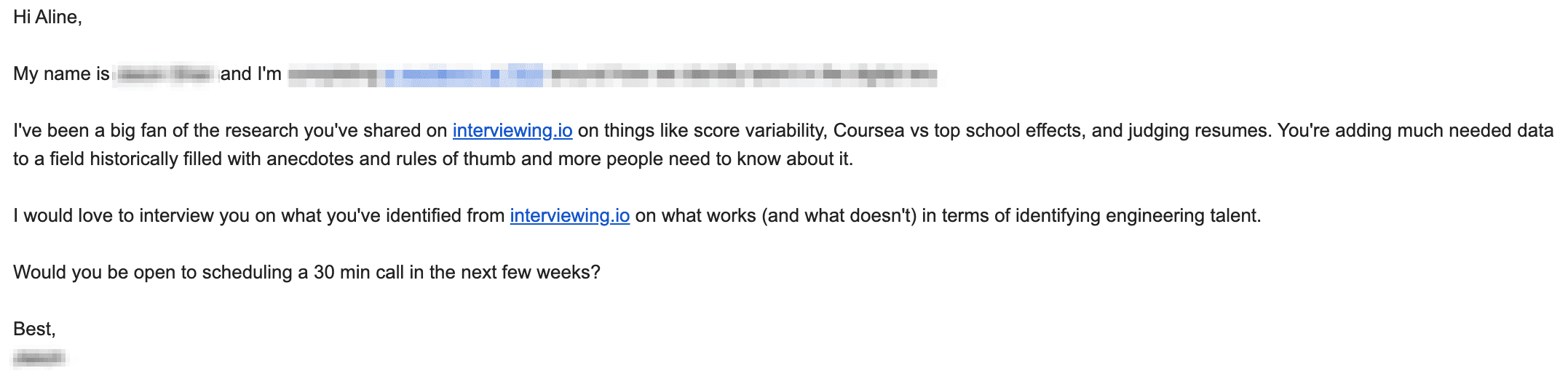
In this email, the candidate doesn’t ask me about jobs — he just asks to meet to discuss a topic. Indeed, he’s done his research. I write a ton about judging resumes, and it’s a topic I could go on about for hours if you’ll let me. His email read like he’s genuinely interested in the subject and that we’d have a good conversation, so of course I responded. You’d be surprised how rare emails like this are. If you can find the topic your target cares about and write something that shows earnest, genuine interest, they’ll respond.
With these emails, you’re asking for a conversation, not a job interview… because the conversation is what will hopefully prove to the hiring manager that you’re worth interviewing. Then, once you have a conversation, the hiring manager will walk away with the impression that you’re a competent, thoughtful human being who’s interested in this sort of work. From there, getting a job interview will feel like an afterthought.
As such, don’t talk about jobs at all in this type of email, and in this particular case, don’t attach your resume — that will feel out of place and transactional. You can and should link to your LinkedIn so they know who you are and have some context. But spend the bulk of the email building common ground and coming up with an interesting reason for the two of you to talk.
This approach is much more effective than asking for an interview out of the gate! You’re not going to land a job from one email, so, as with any seemingly insurmountable goal, it’s important to think of your outreach as a series of steps where you put one foot in front of the other. Like in sales, all you need is to get to a conversation.
If your call to action is to set up a time to talk (which it probably should be because it’s specific), we recommend providing them with a time window. "Would you want to meet up sometime?" puts the burden on the recipient to pose a time, while "Can we talk next Monday at 3pm?" is problematic because, most likely, they aren't free then. Instead, try something like the candidate above did: "Would you be available sometime within the next two weeks for a thirty-minute call? I'm free most weekdays between X and Y and can pretty much do any time on weekends if those are better for you."
Two templates for you to use
Below are two templates you can use for cold outreach. The first one is ideal but requires more effort and can't always be used. The second one is weaker but more generic. You can choose what fits your needs best. We expect both of these templates to be far more effective than throwing your resume into the blackhole of online portals.
Template #1: Use this template if your target has an online presence
This template includes common ground, accomplishments/social proof, and a call to action. It will get you the highest response rates, possibly anywhere from 25-50%. However, it can be challenging to use because it requires you to 1) do a deep dive into their online presence and 2) tie what you find back to something you’re doing. Sometimes, that tie-in might be tenuous or non-existent (in which case, maybe skip it).
Hey {Their First Name},
I’ve read your work on {insert some details about their writing}, and I {insert your thoughts on the work}.
{If you can make the connection between their work and yours, talk about something similar you’ve been working on.}
{If you cannot, ask them a specific, thoughtful question about your work. Don’t worry about making it “the perfect question” like you might when you attend a talk and want to sound smart. Any earnest question will do. You don’t have to use this as a chance to show off!}
{Finally, close with a sentence or two about you, if you have some social proof or impressive accomplishments you can share.}
Would you be up for a quick chat this week or next?
Best,
{Your name}
{Insert 1-2 useful links about you. If you have a personal site, that’s great. If not, a LinkedIn will do.}
Note that in this template, we leave some places for you to insert some social proof and your accomplishments. Even though this email is primarily about them and their work, and your references to yourself are primarily through that lens, it never hurts to drop in a few pieces of evidence that you’re someone who’s accomplished things and/or someone who looks good on paper.
Template #2: Use this template if you don’t have anything except a LinkedIn profile for your target
The reality is that you won’t always have enough information about your target to find common ground. In this case, you’ll lead with accomplishments/social proof and a strong call to action. We expect this template will get you response rates anywhere from 5-25%, depending on the strength of your achievements and pedigree. That said, we recommend treating this template as a last resort. Using it means you’ve exhausted any possibility of writing something personal.
Hey {Their First Name},
{List 2 things about you. They can be impressive accomplishments of yours or social proof, as above.}
I’m really interested in the work you’re doing at {Company Name}. {If you know what team they’re on and are interested in that specific team or are familiar with that team’s accomplishments, great! If not, just write a few earnest sentences about why the company is interesting to you.}
Would you be up for a quick chat this week or next?
Best,
{Your name}
{Insert 1-2 useful links about you. If you have a personal site, that’s great. If not, a LinkedIn will do.}
Keep your note short. The intent here is to make your target believe you’re an entity worth paying attention to, rather than them doing the easy thing: deleting your email.
Regardless of which template you use, just like you have to manage your psychology when you prepare for technical interviews, you have to manage your psychology when doing outreach like this. You have to:
- Mentally prepare yourself for the slog of writing personalized emails and doing the requisite research.
- Get used to rejection. If you do write good emails and target the right people, you’ll have a much better hit rate than when you apply online, but you will still get ghosted a lot, and it will sting much more because, this time, you actually tried. But you know what? If you stick with it and do this right, within a few months, you’ll have a connection to a top-tier company.
Now that you’ve girded your proverbial loins, it’s time to do the work. If you follow our advice, you’ll get 1-2 orders of magnitude more responses than from applying online, and with this approach, you’ll have at least a hiring manager at that company rooting for you!
Footnotes:
Footnotes
-
RocketReach also has a LinkedIn-like faceted search you can use to find engineering managers, but we’ve found that it’s not nearly as reliable or rich as LinkedIn, which is why we recommend using LinkedIn for search and then RocketReach for email discovery. ↩
-
Recruiters should not contact candidates on their work email address, but that's because they're trying to make the candidate leave their job. You are trying to join the manager, which is why it's okay to use their work email address. ↩
-
Many people think that for something to be worth mentioning, it has to have gone viral. That’s simply not correct — in our niche space, a few hundred likes or a few thousand upvotes is already really impressive. ↩

Related posts
Have interviews coming up? Study up on common questions and topics.
We know exactly what to do and say to get the company, title, and salary you want.
Interview prep and job hunting are chaos and pain. We can help. Really.