OpenAI’s Interview Process & Questions
The info below is based on conversations with OpenAI engineers.
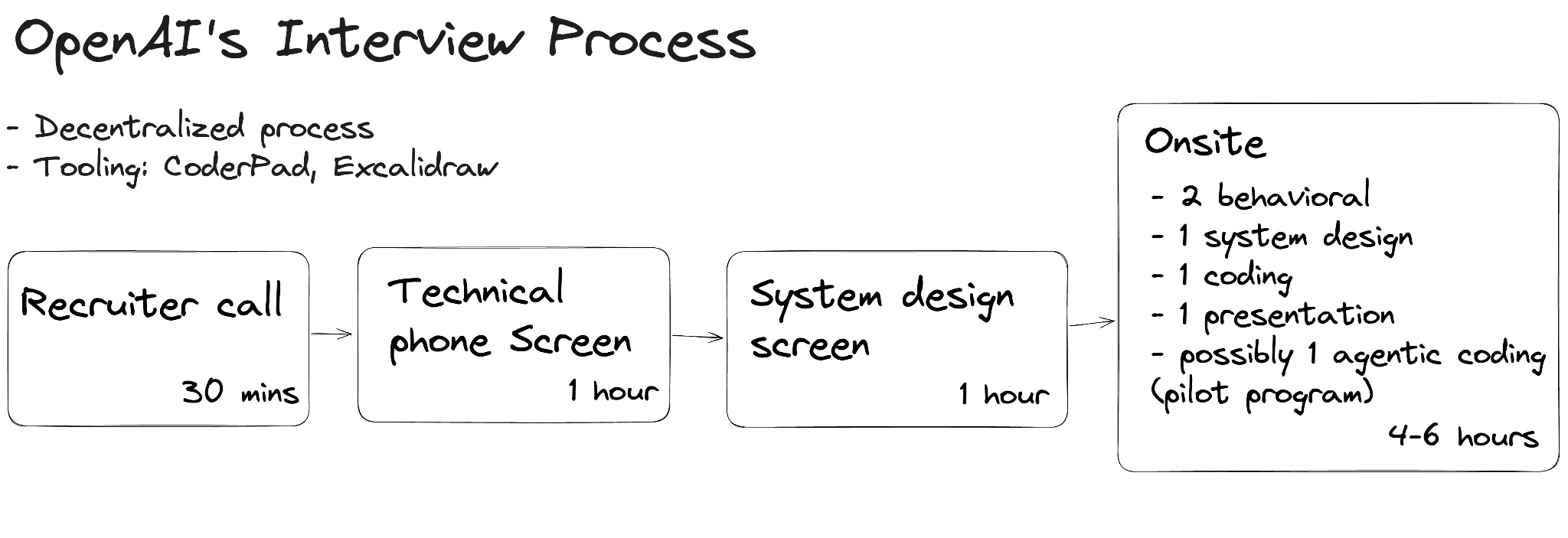
OpenAI's Interview Process for Software Engineers: 3-4 Steps
Mid to senior-level engineers interviewing at OpenAI can expect the following process:
- Recruiter call (30 minutes)
- Technical phone screen (1 hour)
- System design screen (1 hour)
- Onsite (4-6 hours)
General tips:
- Your recruiter will give you detailed tips on what to prepare for before some interviews. Take the tips seriously!
- The coding questions you'll get are more practical than LeetCode. They have an algorithms and data structures component (e.g., traversing a file system), but they are actual things that you might do at work. Some questions also draw on information theory and probability.If it's been a while, a quick refresh before your interviews is worth it.
- Prepare slides for the presentation part of the onsite.
- Be prepared to discuss ethics and safety in AI. Read their blog!
- OpenAI has a reputation for downleveling candidates coming in, so don't anchor your expectations to your current title.
- They are currently piloting an agentic coding round as part of the onsite.
- Be prepared to discuss ethics and safety in AI. Read their blog! It might also be worth comparing OpenAI's approach to Anthropic's - see our Anthropic interview guide.
The hiring process at OpenAI is decentralized, with a lot of variation in interview steps and styles depending on the role and team you are interviewing for. You will get some sort of technical assessment before the onsite, and it can be anything from a technical phone screen, an asynchronous assessment, or a take-home project. It may even be two separate steps. We’ve heard they use HackerRank for asynchronous coding tests but CoderPad for live interviews. This guide will assume that there will be two live technical phone screens, but your mileage may vary depending on team and role – check out OpenAI’s own interview guide for more info.
The hiring process at OpenAI is hybrid, which means that you’re applying to a specific role and team. That said, there is some flexibility in terms of which role and team you might end up on – you might apply to one role but have them suggest others as you move through the process. Your interviewers will probably come from different teams, but the hiring manager interview will be with your future manager.
The entire process can take 6-8 weeks, but if you put pressure on them throughout you can speed things up, especially if you mention that you have other offers from top-tier companies or that you’re in process with the other labs.
AI Usage
AI use in OpenAI interviews is strictly prohibited, except in the beta agentic coding interview.
Step 1: Recruiter Call
OpenAI’s recruiter call lasts 30 minutes, and it’s pretty standard fare – they’ll ask you about your previous experience, why you’re interested in OpenAI, your understanding of OpenAI’s value proposition, and what you’re looking for moving forward.
In this round, your recruiter will also tell you what to expect in the next round, given how much variability there is in the interview process for different roles and teams. Your recruiter will also be in touch throughout the interview process to prep you for what’s coming up next.
It’s really important, at this stage, to not reveal your salary expectations or where you are in the process with other companies. We’ve written a detailed post about salary negotiation that lays out exactly what to say if recruiters pressure you to name the first number.
Step 2: Technical Phone Screen
OpenAI’s first technical phone screen lasts about an hour and is conducted in CoderPad. This is an algorithms and data structures style interview, but the questions are more practical than questions you’d find on LeetCode. We will cover what we know of their question style in the section called “Types of Interview Questions to Expect at OpenAI” below.
Step 3: System Design Screen
This is a system design interview conducted in Excalidraw. You'll be asked to architect a complete system from scratch, and the interviewer will probe your decisions with follow-up questions on scalability, reliability, and trade-offs. See the System Design section below for more details on question types.
Steps 2 and 3 are sometimes scheduled back-to-back in a single session rather than as separate steps spread across days or weeks — effectively a mini-onsite before the onsite. If that's the format you're given, the question styles are the same as described; you're just doing them consecutively.
If you have more information about this part of the process or see anything that’s incorrect, please fill in our form
Step 4: Onsite
Onsite interview loops also vary slightly depending on the role and seniority, but the below is generally what you’ll get:
- Agentic coding (beta) OpenAI is currently testing an additional round where you're given a prompt, an existing codebase, and a problem too complex to solve by writing code from scratch. This round is in beta, so not all candidates will encounter it. For more detail about the kinds of questions to expect, see the Coding section below.
- Behavioral interview with a senior manager (45 mins) This is a phone call with a hiring manager, typically someone quite senior at the company. For more detail about the kinds of questions to expect, see the Behavioral section below.
- Presentation (45 mins) You'll be asked to prepare a presentation on a challenging technical problem that you worked on recently. Prepare slides – this is expected, not just advisable. For more detail, see the Presentation section below.
- Coding (1 hour). This interview will be conducted in your own IDE with screen-share or in CoderPad. Your choice. For more detail about the kinds of questions to expect, see the Coding section below.
- System design (1 hour). You'll use Excalidraw for this round. For more detail about what kind of questions to expect, see the System Design section below.
- Behavioral interview focused on working with teams (30 mins). This and the hiring manager screen above are both behavioral. For more info about what questions to expect, see the Behavioral section below.
Get coached by an OpenAI engineer
Generic prep won’t cut it for OpenAI. Work 1:1 with someone who understands how their interviews actually run—what they’re looking for, where strong candidates fall short, and how to stand out across coding, system design, and the onsite.
Bonus Video: Conversation with an OpenAI Engineer
We spoke to James, now an engineer at OpenAI, and analyzed his mock interview performance. One thing stood out clearly: he continuously communicated his technical reasoning as he worked.
Instead of silently planning a full solution, he worked iteratively and explained decisions as he made them — clarifying constraints early, comparing tradeoffs between approaches, and refining his implementation step by step. When he adjusted his approach, he explained why.
This gave the interviewer clear visibility into how he reasoned about performance, edge cases, and design decisions. In OpenAI interviews, where the technical bar is extremely high, this kind of technical overcommunication helps demonstrate the judgment and problem-solving ability they’re evaluating.
Types of Interview Questions to Expect at OpenAI
All of OpenAI’s interview questions have a degree of practicality and are usually language agnostic.
Agentic Coding (Beta)
OpenAI is piloting an agentic coding round as part of the onsite. You'll be given an existing codebase, and you’ll have to make some changes and add some features. The problems are scoped to be too large and complex to tackle by hand, so the expectation is that you work through them using an AI coding agent. Not all candidates will get this round while it remains in beta.
Coding
OpenAI’s onsite coding interviews will be more practical than many companies’. Although you will still get algorithmic questions, they are going to be about stuff you might actually do at work.
“You’re not going to get questions on string manipulation.”
In these interviews, they are looking for your ability to write code that is going to be fast enough now but flexible enough to scale and adapt in the future.
Questions are multi-part, and you can expect around four parts. Time is tight and most candidates use every second available. Focus on getting a clean working solution for the core parts before pushing into the optional ones. A weak coding score can affect your offer even if you perform strongly elsewhere. OpenAI wants engineers who can ship, not just design. You can choose the language for the coding rounds, and the questions are picked based on whichever language you choose.
We've also seen math-heavy coding questions drawn from information theory and probability. Recent examples include:
- Implementing KL divergence for continuous distributions (the formula is provided, but you need to be able to integrate it and interpret the result)
- Calculating the expected number of iterations for a probabilistic function
- Finding the minimum error of a distribution using cross entropy (formula provided)
These questions aren't hard if you're fresh on the material, but they can catch you off guard if you haven't touched this area in a while. An introductory text on information theory covers everything you'd need.
Below are the technical topics you’re likely to encounter in OpenAI interviews. To compile this list, we did two things. First, we spoke to some current and former OpenAI engineers. Then we cross-referenced all the anecdotes we heard with Glassdoor data AND our own data-set of mock interviews.
First, here’s a list of more niche technical topics that are, in our experience, specific to OpenAI:
- Time-based data structures
- Versioned data stores
- Coroutines in your chosen language (multithreading, concurrency, etc.)
- Object-oriented programming concepts (abstract classes, iterator classes, inheritance, etc.)
And here are technical topics that you’re likely to find at other companies as well (for these we’ve created detailed write-ups of their own):
System Design
You may get two system design rounds during the interview loop, one before the onsite and one during.
If you get one before the onsite, expect something practical – you might be asked to design Yelp, Foursquare, Twitter, or a notifications system.
In this round, they probe for depth of knowledge and will ask a bunch of follow-up questions. It’s also best not to name-drop names of tools:
“If you call out any specific technologies during this round, be prepared to go into detail about them! It may be best not to bring up specific examples as they seem to like drilling into the pros and cons of your choice.”
Although a more domain-specific interview may pop up for some roles, most engineers will get another system design round during the onsite. You will likely be prepped well for the topic of this interview, so pay attention to any tips they give you beforehand. If you got a system design round before the onsite, the style of question that you get in the onsite round will be very similar, though they may ask you to get into more detail.
We have heard that OpenAI might ask you to code in this interview. One user told us that they designed a solution to the problem that was posed to them but were then asked to code up a new solution using a different method.
Check out our guide to system design interviews to help you prepare.
Presentation
You'll be asked to present a challenging technical problem you worked on recently to a senior manager. You might not explicitly be asked to prepare slides, but it’s a very good idea to do so anyway. Be prepared to discuss the technical and business aspects and impact of the project, as well as your level of contribution, what tradeoffs were made, what other team members were involved, and what everyone’s responsibilities were. You may get some behavioral questions about how you worked with the team.
Behavioral
Senior Manager Call
This is often with someone pretty high up at OpenAI. Our sources tell us it can be an interesting call. Although a lot of the questions will be standard, you may also be asked to delve deeper into something on your resume that catches the eye.
From one source who interviewed with OpenAI recently:
"This interview was with John Rizzo, who is a well-known employee at OpenAI. It wasn’t an intense call, and John asked me some great questions about my background. It felt like he might have had veto power, but I enjoyed the call."
It’s also a good idea to read OpenAI’s blog, particularly any articles that discuss ethics and safety in AI. They want to know that you’ve thought about the topic, so prepare yourself!
Working with Teams
This is another type of behavioral interview you might encounter. Expect questions about times:
- You had to work cross-functionally across teams
- You’ve experienced conflict between teams or roles
- You’ve had competing ideas to move a project forward within your own team.
All of these questions are meant to get at your ability to work collaboratively, particularly across disciplines. At OpenAI, that means working alongside researchers, product managers, and safety teams, not just other engineers. Generic teamwork stories won't cut it here; the more you can speak to cross-functional or research-driven environments, the better.
See something inaccurate? Please fill out this form, and tell us about it.

About interviewing.io
interviewing.io is a mock interview practice platform. We've hosted over 100K mock interviews, conducted by senior engineers from FAANG & other top companies. We've drawn on data from these interviews to bring you the best interview prep resource on the web.