Duolingo’s Interview Process & Questions
The info below is based on conversations with Duolingo engineers.
Duolingo's Interview Process for Software Engineers: 4 Steps
Mid to senior-level engineers interviewing at Duolingo can expect the following process:
- Recruiter screen (1 hour)
- Technical phone screen (1 hour)
- Pair programming exercise (1 hour 15 minutes)
- Onsite 3-4 hours)
General Tips:
- Technical Preparation: Focus on object-oriented programming concepts and data structure implementation rather than pure algorithm grinding. Practice working within existing codebases and understanding frontend-backend interactions.
- Language Proficiency: Ensure you're comfortable coding efficiently in Python or Java, as you may not have full language choice flexibility.
- Environment Setup: Be prepared for technical setup challenges during pair programming. Test your development environment and screen sharing capabilities beforehand.
- Product Understanding: Duolingo values engineers who understand how backend systems impact user-facing features. Their interview structure reflects their focus on engineers who can bridge technical implementation with user experience.
- Frontend-Backend Connection: Keep in mind that Duolingo "leans heavily into backend systems that change the frontend," so experience with user-facing backend work is particularly valuable. If your background is primarily in deeper backend systems without frontend interaction, be prepared to demonstrate how your skills translate to their product-focused environment.
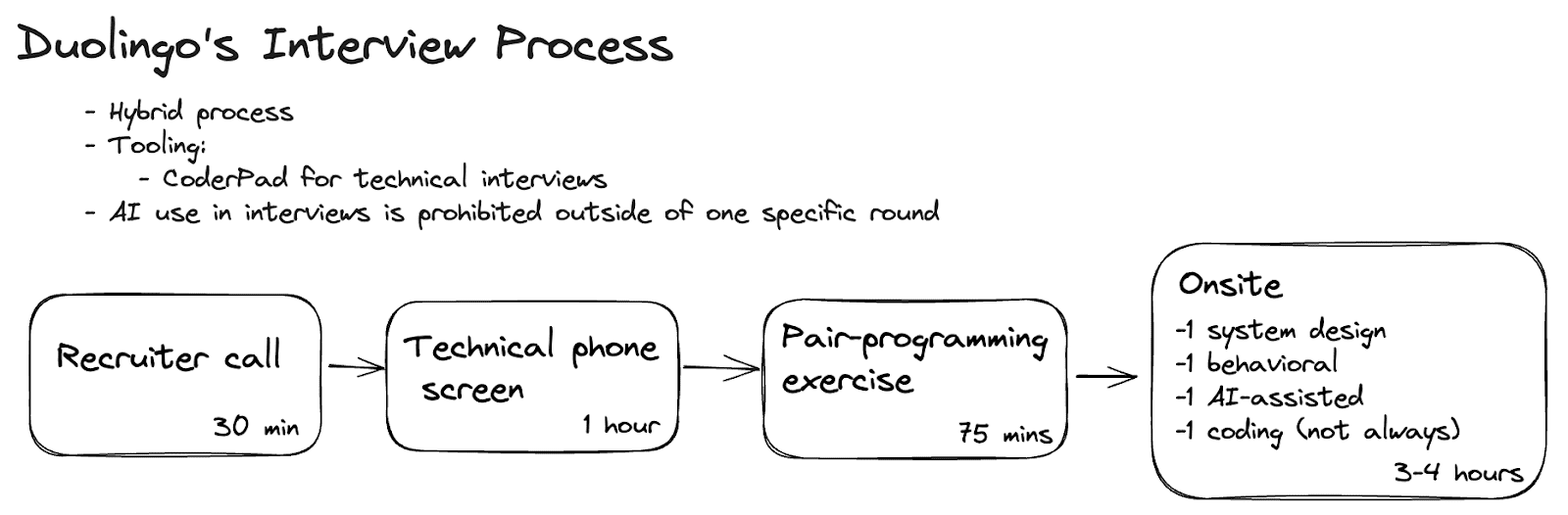
Duolingo has a hybrid process where you interview for a specific team or role, but the interviewers aren't necessarily from that team. While there's no formal team matching phase, if your target position gets filled during the process, they'll consider you for other open roles within the company. The entire process takes about 4-6 weeks, though this can vary based on scheduling and role availability.
AI Usage
Except for in the designated AI-assisted round, AI use in interviews is strictly prohibited.
Step 1: Recruiter Call
Duolingo's recruiter screen lasts 1 hour and covers standard ground. They'll ask you to tell them about yourself, explain why you're interested in Duolingo, and walk through behavioral scenarios like times you had to work collaboratively or received feedback. The conversation is more probing than surface level but remains conversational rather than deeply technical.
It’s really important, at this stage, to not reveal your salary expectations or where you are in the process with other companies. We’ve written a detailed post about salary negotiation that lays out exactly what to say if recruiters pressure you to name the first number.
Step 2: Technical Phone Screen
Duolingo's technical screen lasts 1 hour and features two engineers (one interviewing, one shadowing). This pattern of having two engineers present continues throughout all technical rounds.
You might encounter a LeetCode medium-level object-oriented programming question. Expect problems like defining a class and method to detect underlying data structures (heap, stack, cube, or combinations) based on input streams. For instance, they might ask you to implement "put this value, get this value" operations based on sequences, then probe deeper: "How would you determine which data structure fits this sequence if you aren't guaranteed the pattern?"
This round requires solid understanding of data structures and big O notation. The interview is conducted in CoderPad.
Step 3: Pair Programming Exercise
This 1 hour 15 minute session is conducted live using VS Code with live sharing extensions. Duolingo will send you setup instructions beforehand.
You'll work within their existing codebase structure with significant boilerplate already provided. They'll show you a frontend interface and ask what backend changes you'd need to implement to modify the frontend behavior. According to one engineer we spoke to:
This round can be "really tough, mainly because of the structure" and may involve technical difficulties getting the development environment running properly.
An engineering manager (not the hiring manager) typically observes this round.
Step 4: Onsite
Duolingo uses their own interview portal for scheduling and messaging, where you can see the names of everyone in your interview loop. All onsite rounds last 1 hour each and typically include:
- Behavioral (1 hour). Conducted by a manager (though not necessarily your target hiring manager). For more detail about the kinds of questions to expect, see the Behavioral section below.
- System Design (1 hour). For more detail about the kinds of questions to expect, see the System Design section below.
- Possible Extra Coding Screen. If they need additional signal, they may include an extra coding round, though not all candidates receive this. They typically use CoderPad. For more detail about the kinds of questions to expect, see the Coding section below.
- AI-Assisted Assessment (1 hour). Duolingo is currently testing this experimental round where you build something using AI tooling. For backend roles, you might be asked to "Build an API system that manages translations - find a phrase and translate it on the backend."
Types of Interview Questions to Expect at Duolingo
Duolingo's questions blend practical programming challenges with computer science fundamentals. Unlike pure algorithm-focused interviews, their questions often involve object-oriented design and real-world system interactions.
Duolingo is very heavy on Python; they recently standardized on Python as their backend language. While some flexibility exists, you'll likely need to use Python or Java, and efficiency in these languages is crucial.
Questions emphasize understanding data structures, object-oriented programming principles, and the ability to work within existing codebases. Expect medium-difficulty problems that require both algorithmic thinking and practical implementation skills.
One engineer who recently went through the process said:
My interviewers seemed less engaged at times, possibly due to having two people present in each technical round.
Coding
This interview will focus on object-oriented programming and data structure implementation rather than pure algorithmic challenges. Expect questions like:
- Define a class and method to detect underlying data structures based on input streams
- Implement operations for heap/stack/cube combinations
- Determine which data structure fits a sequence pattern
Regardless of what question you get, they'll probe your understanding of big O notation and ask about your decision-making process. They want to know why you approach problems in certain ways and look for practical implementation skills within existing codebases.
System Design
System design rounds follow industry standards but tend to focus on user-facing systems that connect frontend and backend components. Given Duolingo's product focus, understanding how backend changes impact user experience is particularly valued. Expect problems like "Design a system that manages a library with book check-in and check-out functionality."
Behavioral
Behavioral interviews focus on collaboration, feedback reception, and problem-solving in team environments. The conversational style suggests they're looking for cultural fit alongside technical competency. This is usually conducted by a hiring manager, though not the hiring manager specific to your role.
AI-Assisted Assessment
Duolingo is testing an AI-assisted round. You’ll be allowed to use any AI you like, and they are looking for a fully functional end state. For backend roles, you might be asked to build an API that manages translations. They want you to show that you can break down an ambiguous requirement into clear user stories.
See something inaccurate? Please fill out this form, and tell us about it.

About interviewing.io
interviewing.io is a mock interview practice platform. We've hosted over 100K mock interviews, conducted by senior engineers from FAANG & other top companies. We've drawn on data from these interviews to bring you the best interview prep resource on the web.