Grammarly’s Interview Process & Questions
The info below is based on conversations with Grammarly engineers.
Grammarly's Interview Process for Software Engineers: 4 Steps
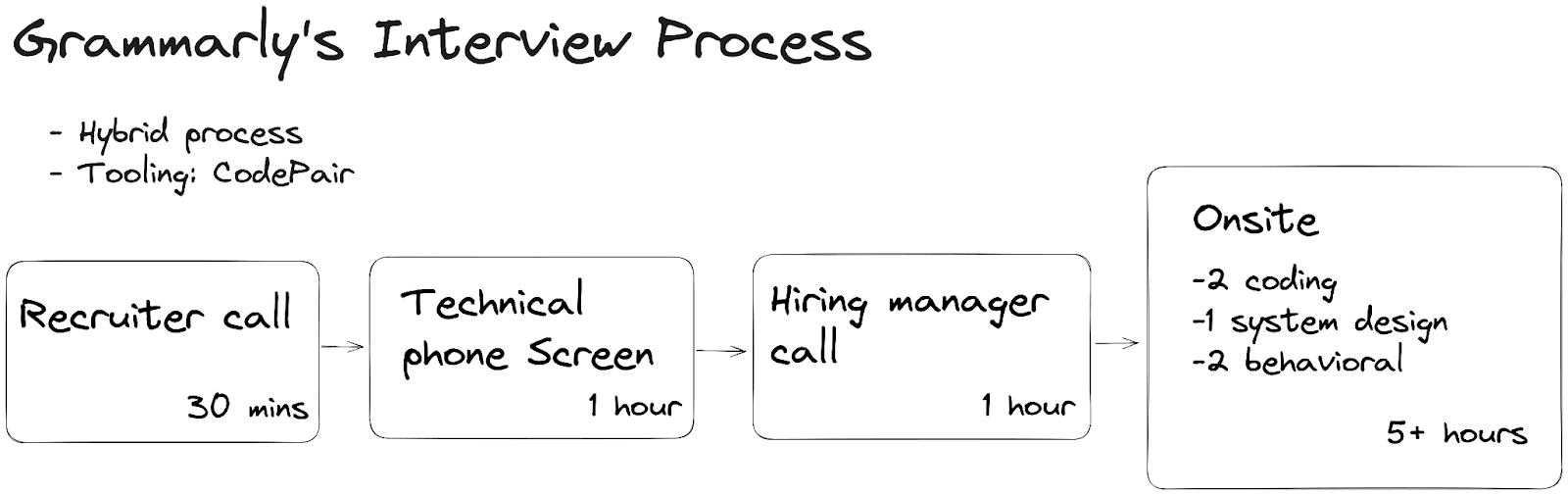
Mid to senior-level engineers interviewing at Grammarly can expect the following process:
- Recruiter call (30 minutes)
- Technical phone screen (1 hour)
- Hiring Manager screen (1 hour)
- Onsite (5.5 hours)
General tips:
- Having a referral guarantees a call-back (not true at many other companies).
- Grinding on LeetCode will help because they primarily ask questions straight from LeetCode.
- They can be slow, so don’t be afraid to follow up a lot and keep reminding them you have other offer deadlines.
- Learn their EAGER framework of values. They will want you to know these and align with them during your interviews.
- It's a foreign-founded company, so you may encounter interviewers who aren’t native English speakers and have a different cultural style than you’re used to.
Grammarly has a hybrid process, which means that you will interview for a specific team and role but your interview panel will be a mix of engineers from the team and from elsewhere in the company. It will also include the hiring manager for the role you are interviewing for.
The entire process takes about 6 weeks, but our sources tell us it shouldn’t have to – by default, Grammarly is slow in moving things forward, but if you’re proactive, you can speed up the process.
Step 1: Recruiter Call
Grammarly’s recruiter call lasts about 30 minutes, and it’s different from a lot of recruiter screens. Be prepared to get asked questions that require STAR-style responses. One of our sources was surprised by the style of question they got at this stage, so be prepared!
It’s also really important, at this stage, to not reveal your salary expectations or where you are in the process with other companies. We’ve written a detailed post about salary negotiation that lays out exactly what to say if recruiters pressure you to name the first number.
Step 2: Technical Phone Screen
Grammarly’s technical phone screen lasts about an hour. It will be conducted in HackerRank, and you should expect medium-difficulty LeetCode-style questions.
Step 3: Hiring Manager Screen
This is a presentation and a deep dive into a complex project that you’ve worked on. For more senior roles, you’ll be asked to describe a project you led.
We’ve heard that you may not necessarily get clear instructions about this round, and you may not be told to prepare a presentation in advance, but we heartily recommend that you do! One of our sources did well in this round because he already had a presentation prepared for another company and was able to seamlessly jump into it when he realized what the call was about. Though it may not be critical to have a presentation fully prepared, doing so will give you an edge. Either way, come prepared to discuss the overall architecture (including diagrams as needed), what problem you were trying to solve, and your role in the successful completion of the project.
Step 4: Onsite
We’ve heard that Grammarly’s onsite is very long and can be split across multiple days.
- Product intuition/domain expertise (1 hour). This interview will be conducted in CodePair (HackerRank’s coding interview tool). For more detail about the kinds of questions to expect, see the Coding section below.
- System design (1 hour). This will likely be in Miro or HackerRank's whiteboarding tool. For more detail about the kinds of questions to expect, see the System Design section below.
- Coding / CS fundamentals (1 hour). This interview will be conducted in CodePair. For more detail about the kinds of questions to expect, see the Coding section below.
- Coffee chat (virtual) (30 minutes). You meet with two people from your future team and get to ask them questions.
- Values call 1 (1 hour) This interview will be with someone from Grammarly who isn’t from the org or team you are applying to. For more info about what questions to expect, see the Values section below .
- Values call 2 (1 hour) This interview will be conducted by a hiring manager. For more info about what questions to expect, see the Values section below .
Types of Interview Questions to Expect at Grammarly
From what we’ve heard, Grammarly doesn’t ask practical questions. They do have a standard bank of questions they regularly ask, and LeetCode-style questions are common.
Product Intuition / Domain Expertise
This might be a two-part question and varies by role. In the first part, you could be shown an email with the Grammarly tool engaged and certain words or phrases highlighted. Your job will be to improve the product.
The second part will involve a standard LeetCode-style question.
Coding
Expect another two-part interview here with standard LeetCode-style questions in the first part.
The second part might be a lot more academic. One source told us:
"The second problem looked like it came straight out of an algorithms textbook.”
Below are the technical topics you’re likely to encounter in Grammarly interviews. To compile this list, we did two things. First, we spoke to some current and former Grammarly engineers. Then we cross-referenced all the anecdotes we heard with Glassdoor data AND our own data-set of mock interviews:
System Design
This will likely be a two-part question where you’re asked to design something at a small scale in the first part and then asked to scale it up in the second. Time management is critical here because they will ask lots of questions during the first part. We’ve heard that this is a tough interview, but that you can do poorly, and potentially get a chance to redo it after the onsite.
Areas to focus on are:
- Client-server communication
- Separation of concerns
- Data structures and flows
- A system’s extensibility and scaling
Check out our guide to system design interviews to help you prepare.
Values
You will have two calls that focus on Values, one with a hiring manager and the other with someone from a completely different part of the company. One of the people we interviewed for this guide was interviewed by someone from the Social Media team.
Both calls will ask questions about your past work experience. They will use your resume and frame their questions around your past companies. Be prepared to use their EAGER framework of values, and show that you understand and embody the values they are looking for. EAGER stands for Ethical, Adaptable, Gritty, Empathetic, and Remarkable. Look for ways to show that you embody these values as you go through your interviews, even the technical ones.
Expect to go through each company you’ve worked from and answer questions like:
- What would your manager say your strengths were?
- What would your manager say your weaknesses were?
- What would you say your manager's strengths were?
- What would you say your manager's weaknesses were?
How Grammarly Makes Hiring Decisions
The entire onsite panel submits written feedback after the interviews are completed and then meets to discuss. Most of the time, decisions are reached by consensus (everyone agrees to hire or no-hire), but in cases where consensus isn’t possible, the hiring manager has the final say.
See something inaccurate? Please fill out this form, and tell us about it.

About interviewing.io
interviewing.io is a mock interview practice platform. We've hosted over 100K mock interviews, conducted by senior engineers from FAANG & other top companies. We've drawn on data from these interviews to bring you the best interview prep resource on the web.