Figma’s Interview Process & Questions
The info below is based on conversations with Figma engineers.
Figma's Interview Process for Software Engineers: 4-5 Steps
Mid to senior-level engineers interviewing at Figma can expect the following process:
- Recruiter call (30 minutes)
- Hiring manager call (45 mins)
- Technical phone screen (1 hour)
- Onsite (4 hours)
- Additional “Executive Screen” for Staff-level engineers (1 hour)
Staff-level engineers (or even Seniors on the cusp of Staff) can sometimes get an additional round after the onsite. This is an executive screen, which is essentially a behavioral interview with the director of the team you are interviewing for.
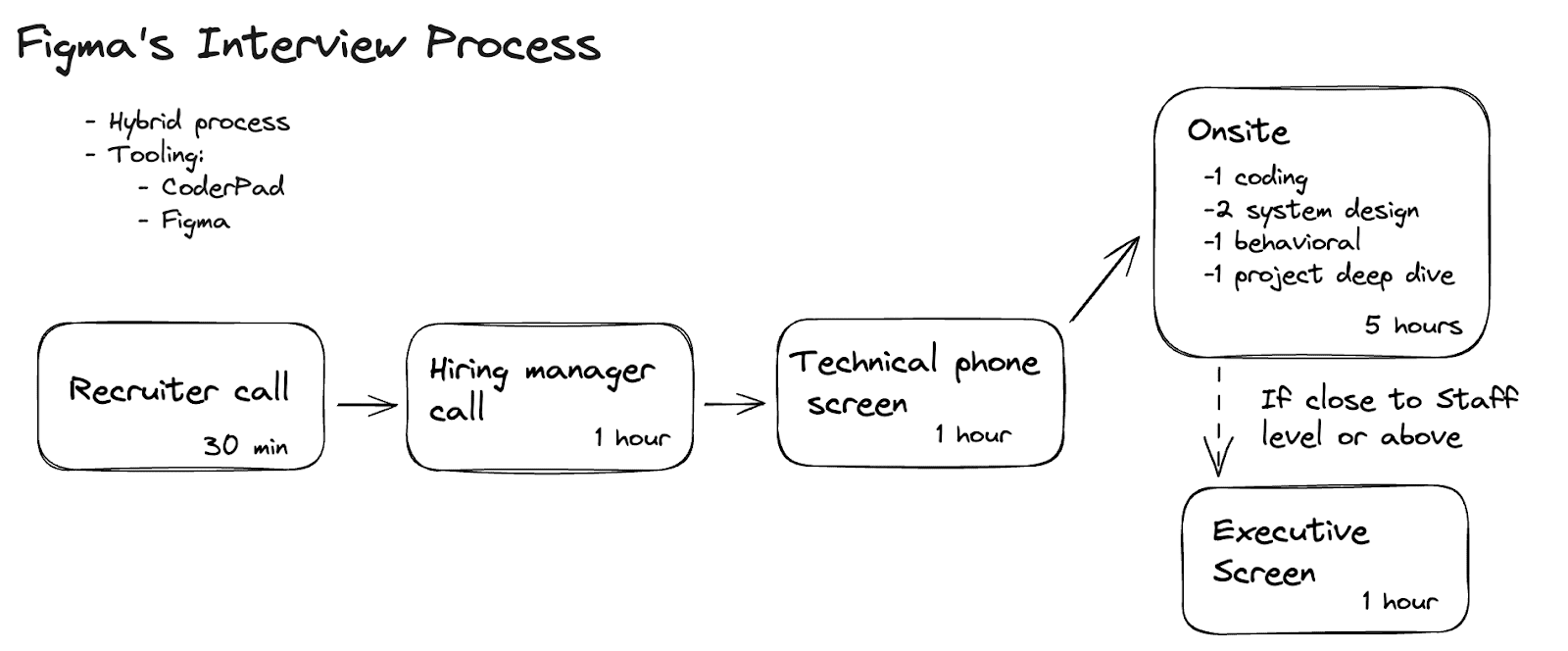
Figma’s hiring process is a hybrid. Although you apply for a specific team from the get-go, your interviews will likely not be with the people on your team – interviewers are randomly selected from a pool – except for the hiring manager interview and the executive screening (if applicable).
General tips:
- You’ll get a guide to Figma’s hiring process that includes a lot of useful information
- Their interview process is language-agnostic
- Brush up on general algorithms and data structures, but be prepared for them to use Figma terminology when they pose the questions
- They say you can only apply to one role at a time, so pick wisely
- Try to get a referral; it’s hard to get into the process otherwise
- Learn as much as you can about Figma’s architecture
- Express why you like the product and why you want to join–they are on the path to IPO and getting a lot of high-quality applicants
The entire process takes about 3-4 weeks, but we heard they can move faster if needed.
Step 1: Recruiter Call
Figma’s recruiter call lasts 30 minutes, and it’s pretty standard fare – they’ll ask you about your previous experience, why you’re interested in Figma, your understanding of Figma’s value proposition, and what you’re looking for moving forward.
It’s really important, at this stage, to not reveal your salary expectations or where you are in the process with other companies. We’ve written a detailed post about salary negotiation that lays out exactly what to say if recruiters pressure you to name the first number.
Step 2: Hiring Manager Call
This is a pretty standard behavioral call with the hiring manager of the team you are interviewing for. Expect some questions about your background and experience but also some information about the team and what they are working on. You’ll get time to ask your own questions too.
Step 3: Technical Phone Screen
This interview is scheduled as a block with the hiring manager call above and will be conducted in CoderPad. The questions will be algorithmic, but they will be set in a Figma context. In other words, they might pose a problem they run into at Figma and ask how you’d solve it with code, or ask you a very standard algorithmic question, but layer in some Figma terminology. It’s a good idea to brush up on Figma’s names for the various components they use. You can find information here. Expect about a medium in terms of LeetCode-level.
Step 4: Onsite
At this point, candidates split into different loops depending on the role they are interviewing for e.g., ML, frontend, backend etc. Onsite interview loops also vary slightly depending on the role and seniority, but the below is generally what you’ll get:
- Coding (1 hour). This interview will be conducted in CoderPad. For more detail about the kinds of questions to expect, see the Coding section below.
- System design (1 hour). This interview will be conducted in Figma. For more detail about the kinds of questions to expect, see the System Design section below.
- Second system design (1 hour) This interview will be conducted in Figma. For more detail about the kinds of questions to expect, see the System Design section below.
- Behavioral (1 hour). For more info about what questions to expect, see the Behavioral section below.
- Project deep dive (1 hour) For more info about what questions to expect, see the Project Deep Dive section below.
[Staff-level or Close to It] Step 5: Executive Screen
If you’re interviewing for a Staff level role, or quite senior and on the cusp of Staff, they will do one more round after the onsite. It is a behavioral round with a Director. They might tell you this is a casual chat, but one engineer said:
The Director clearly used all the feedback given during the onsite and intentionally drilled into areas that were outside of what I’d covered before. This was very intense!
Types of Interview Questions to Expect at Figma
Coding
This will likely be algorithms and data structures-focused but will skew more practical than typical LeetCode questions. Expect about a LeetCode-medium level of difficulty. An engineer we spoke called described them as
Pretty standard algorithms and data structures questions, but they are all Figma-flavored.
Sample questions include:
- Implement a Figma doc with layers, properties, class definitions, and ways to update
- Print out objects on a 2D canvas in a sequential order, left to right and top to bottom
Below are the technical topics you’re likely to encounter in Figma interviews. To compile this list, we did two things. First, we spoke to some current and former Figma engineers. Then we cross-referenced all the anecdotes we heard with Glassdoor data AND our own data-set of mock interviews:
System Design
You will get two system design rounds:
- Relating to Figma components and how to design a feature around them
- Another that is more focused on your specific role
They will send you a public guide to Figma components to help with the first system design round, so brush up on that. Components are like classes in Figma. The second round will lean more towards the type of work you will be doing, e.g., back-end or front-end.
As with the coding interviews, expect something practical here. It will very likely be related to an issue that Figma has encountered before. You might be asked to design a poll system within Figma that can handle multiple concurrent users. Expect to be asked about scaling and storage options.
Check out our guide to system design interviews to help you prepare.
Behavioral
This interview will be conducted by a hiring manager from within the same organization but not the team you are interviewing for. It’s going to be pretty standard, with questions about:
- How you’ve handled feedback in the past
- How you approach conflict
- Past projects you’re proud of
Project Deep Dive
For this interview, you’ll be asked to prepare a few slides on a previous technical project you’ve worked on. It’s a pretty interactive session where they’ll dig into:
- The scale and scope of your role on the project
- The technical details of the project
- What issues you ran into
- What tradeoffs were made
- What you’d do differently
Unlike some project deep dives we’ve come across, this will likely be with only one interviewer.
Executive Screen
All we can say is that this is a behavioral round. It’s hard to say what the Director will ask during this session, but they will be looking for any areas left unturned during the onsite and drilling into them.
See something inaccurate? Please fill out this form, and tell us about it.

About interviewing.io
interviewing.io is a mock interview practice platform. We've hosted over 100K mock interviews, conducted by senior engineers from FAANG & other top companies. We've drawn on data from these interviews to bring you the best interview prep resource on the web.