Should you outsource your technical interviews? And should you use us or Karat?
We’ve recently entered the outsourced interview business (which has historically been dominated by the good people at Karat).
The pieces had been there for a while. Meta had used our tooling to conduct their own interviews, several top-tier VCS had used us to help them vet their talent pool, companies routinely use us to help their engineers prepare for an acquisition, and, most importantly, hundreds of thousands of engineers have used us to practice for their own interviews over the last decade.
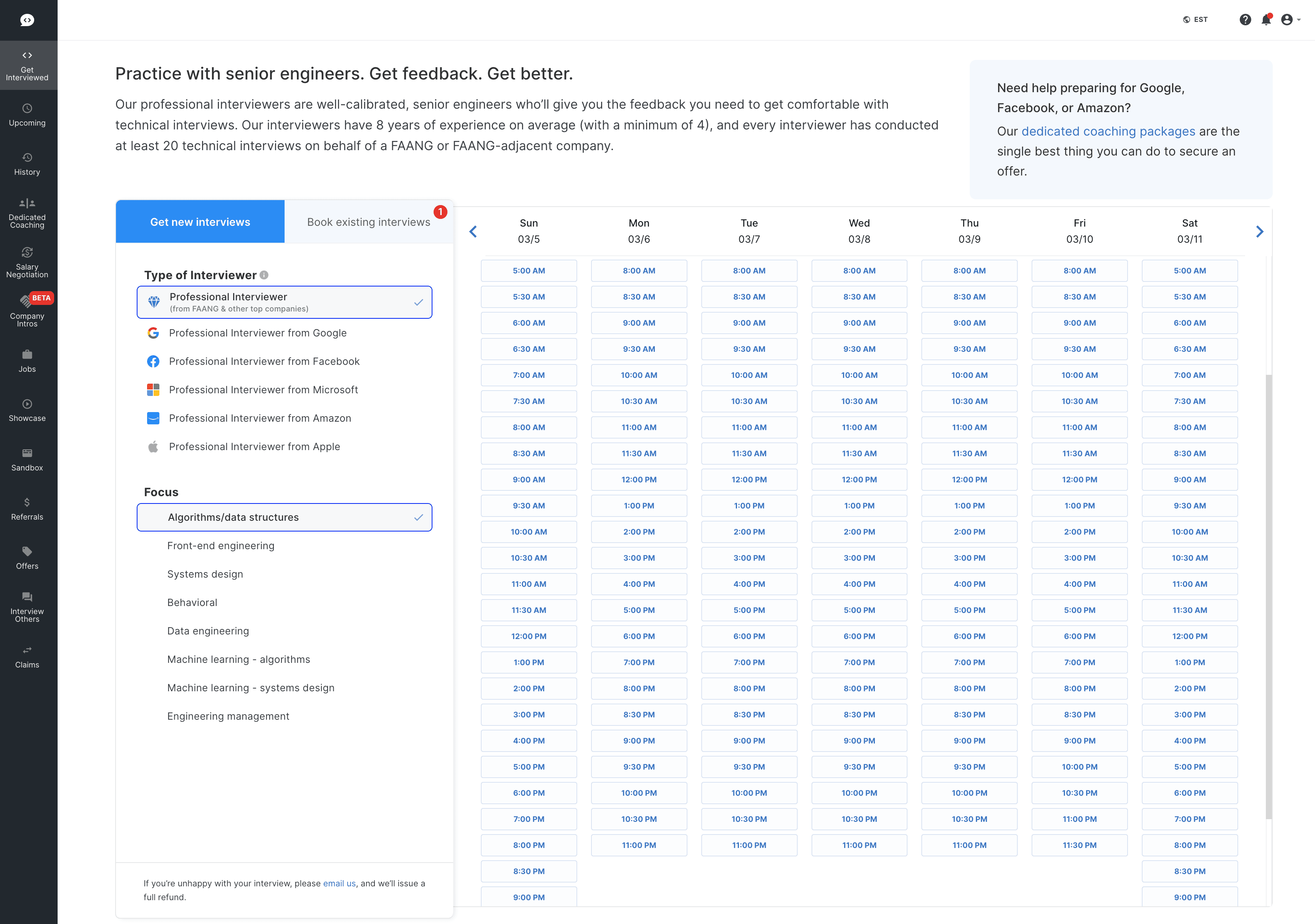
So, we're finally doing it! Our big differentiator is interviewer background and experience. Our interviewers are senior, staff, and principal engineers from FAANG, FAANG+, and the frontier AI labs. Only the top 5% of interviewers from our mock interview pool qualify to conduct interviews on behalf of customers.
In this post, we talk about whether you should outsource interviewing in the first place, and if so, whether Karat or interviewing.io is the right choice for you.
We built an AI model for eng hiring that outperforms recruiters and LLMs
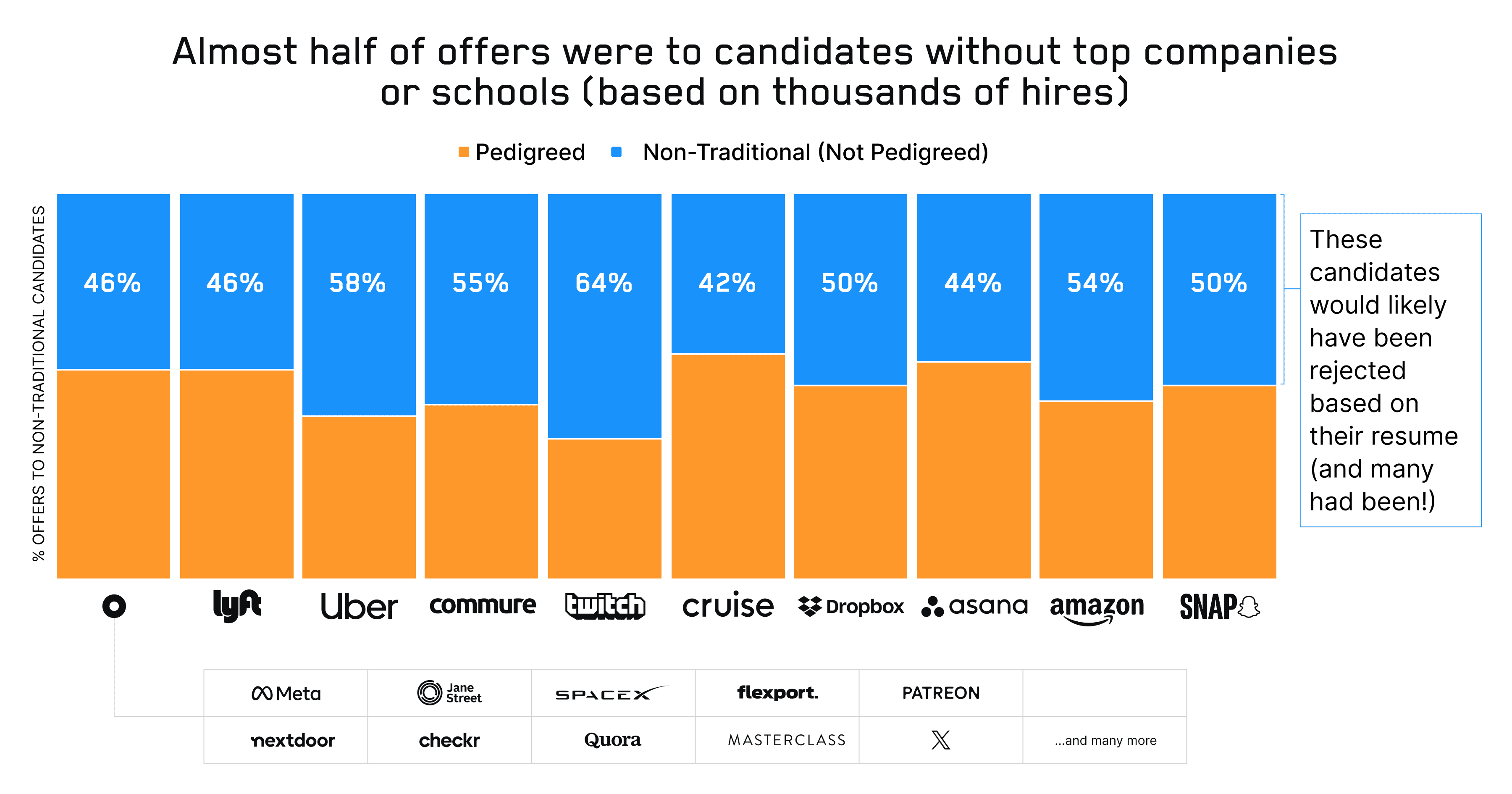
In the last post in our hiring series, I talked about how, for six years, we ran the largest blind eng hiring experiment in history and placed thousands of people at top-tier companies. 46% of candidates who got offers at these companies didn't have top schools or top companies on their resumes. Despite that, these candidates performed as well (or better than) their pedigreed counterparts, were 2X more likely to accept offers, and stayed at their companies 15% longer.
Of course, it's easy to say that you should hire non-traditional candidates. But how do you separate great ones from mediocre ones, when you can't look at brand names on their resumes for signal? The short answer is that it's really hard. We spent years figuring it out.
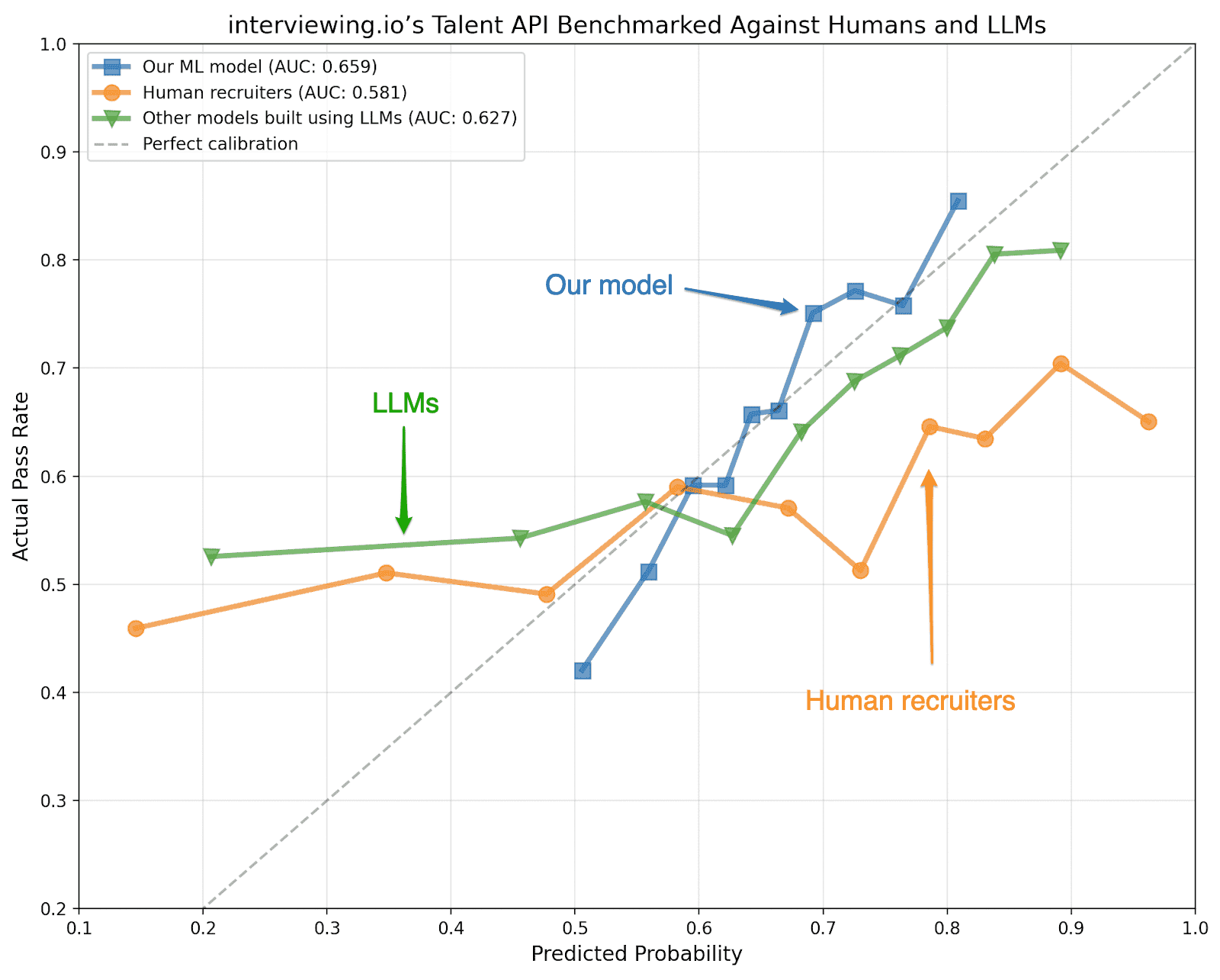
But, we now have a predictive model that outperforms both human recruiters and LLMs and can reliably identify strong candidates, regardless of how they look on paper, just from an (anonymize) LinkedIn profile. Not only can it spot diamonds in the rough, but it can also identify candidates who look good but aren't actually good.
For years, hiring has relied on pedigree and optics because outcomes data was effectively inaccessible (especially data for candidates who don't pass resume screens). We think we've fixed that.
For six years, we ran the largest blind eng hiring experiment of all time. Here’s what happened.
You’ve probably heard about the blind orchestra auditions described by Malcolm Gladwell in Outliers. We did the same thing with eng hiring.
With our blind approach, over six years, we placed thousands of engineers at FAANG and FAANG-adjacent companies and top-tier startups.
46% (almost half!) of those engineers didn’t have either a top school or a top company on their resume. In a normal (not blind) hiring process, these candidates wouldn’t even have gotten an interview.
Read nine chapters of Beyond Cracking the Coding Interview for free

Nine free chapters of Beyond Cracking the Coding Interview. are now available for free.
You can find them here.
They include:
- The first seven chapters of the book, covering topics such as why technical interviews are broken, what recruiters won't tell you, why not to spend a lot of time on resumes, and how to get in the door at companies without a referral.
- Two technical chapters: Sliding Windows and Binary Search. Our new take on Binary Search teaches one template that works for every binary search problem on LeetCode, with only a single-line change you need to remember. The Sliding Windows chapter features 6 unique sliding window templates that make off-by-one errors a thing of the past.
We co-wrote the official sequel to Cracking the Coding Interview!

Gayle Laakmann McDowell, Mike Mroczka, and Nil Mamano, and I have written the official sequel to Cracking the Coding Interview (often called the bible of technical interview prep). The sequel is fittingly called Beyond Cracking the Coding Interview.
We cover everything you need to know for today's tougher technical interviews and hiring climate. We have (at least) thirteen new technical topics and over 150 new problems. We’ve also drawn on a decade of hiring data and 100k interviews from interviewing.io to help you get noticed, manage your job search, and negotiate the best possible offer.

The book is available now, and purchases come with $50 off on interviewing.io... given that it costs ~$45, it's not a bad deal.
Why we’re pausing our Pay Later Program
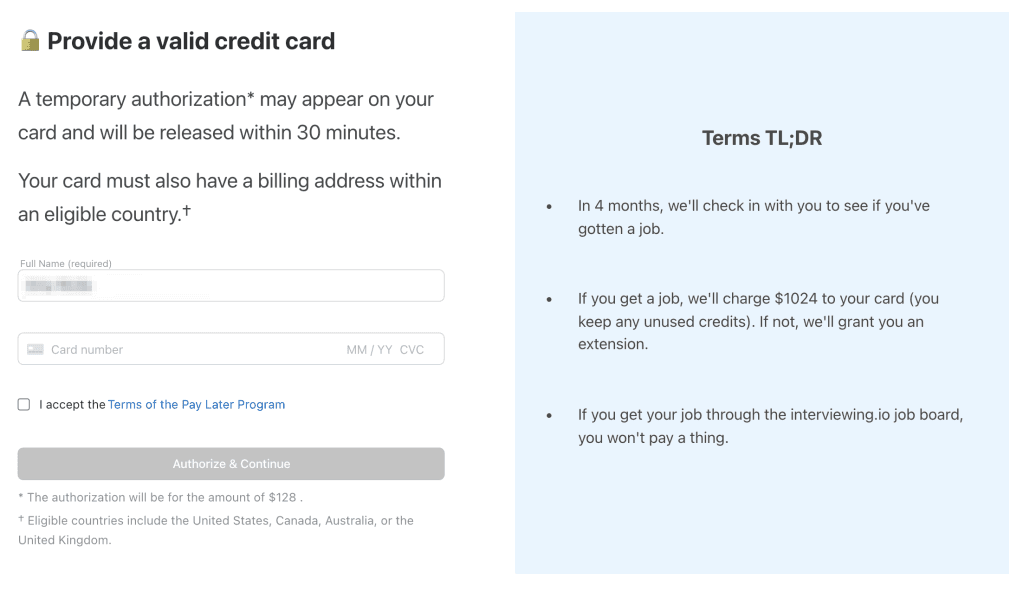
We recently made the difficult decision to pause our Pay Later Program. In this post, we’ll talk about why we made that call and what we’ll be doing instead to ensure that engineers who can’t afford to pay for practice will still be able to get it. We’ll also explain some things we’ve learned along the way about funnel optimization, some mistakes we made while iterating on this program, and what we’ll do differently when we hopefully unpause it in the future.
Building interviewing.io's collaborative & replayable whiteboard, or making systems design interviews not suck
During the spring of 2022, I went from being a user of interviewing.io to being one of the engineers on the team.
I discovered interviewing.io in 2021 while preparing for my internship interviews, little did I know that I would end up interviewing for interviewing.io via an interview conducted on interviewing.io to receive an internship opportunity at interviewing.io upon passing the said interview. Yes.
During my 11 weeks, I solved an important business problem, quadrupled my problem-solving skills, and collaborated with the fantastic folks who built the product made for engineers, by engineers.
Announcing our Pay Later Program: Don’t pay for mock interviews until you get a job

In the wake of COVID, I made a public promise to launch a program where engineers could defer paying for practice until they found a job. Today, we’re making good on that promise by launching our Pay Later Program! With this program, you get instant credits to spend on interview practice and then pay us once you’ve found a job. And if you get a job through our job board, then you don’t have to pay anything…
We’ve raised our Series A!

I’m really excited to announce that we raised a $10M Series A, led by the fine people at M13. This round of funding is a long time coming. I don’t know what the average company age is when successfully raising an A, but it took us 6 years to get here. It was a long and windy path, and for a little while, we almost died (more on that below), but we’re still here, and we’re so grateful and excited to finally have the resources to do what we’ve always wanted to do: fix hiring, for real. What does “fixing hiring” mean? We believe that the only way to really effect change, is to make …
Announcing the interviewing.io Technical Interview Practice Fellowship

I started interviewing.io because I was frustrated with how inefficient and unfair hiring was and how much emphasis employers placed on resumes. But the problem is bigger than resumes. We’ve come to learn that interview practice matters just as much. The resume gets you in the door, and your interview performance is what gets you the offer. But, even though technical interviews are hard and scary for everyone — many of our users are senior engineers from FAANG who are terrified of getting back out there and code up the kinds of problems they don’t usually see at work while someone breathes down their neck — interview prep isn’t equitably distributed. This inequity never really …
interviewing.io is finally out of beta. Anonymous technical interview practice for all!

I started interviewing.io 5 years ago. After working as both an engineer and a recruiter, my frustration with how inefficient and unfair hiring had reached a boiling point. What made me especially angry was that despite mounting evidence that resumes are poor predictors of aptitude, employers were obsessed with where people had gone to school and worked previously. In my mind, any great engineer, regardless of how they look on paper, should have the opportunity to get their foot in the door wherever they choose. So, we set out to build a better system. On interviewing.io, software engineers can book anonymous mock interviews with senior engineers from companies like Facebook, Google, and others, and if …

Most popular posts
We know exactly what to do and say to get the company, title, and salary you want.
Interview prep and job hunting are chaos and pain. We can help. Really.