Dropbox’s Interview Process & Questions
The info below is based on conversations with Dropbox engineers.
Dropbox's Interview Process for Software Engineers: 4 Steps
Mid to senior-level engineers interviewing at Dropbox can expect the following process:
- Recruiter call (30 minutes)
- CodeSignal assessment (1 hour)
- Onsite loop - Set 1 (3 hours)
- Onsite loop - Set 2 (2 hours)
Staff-level and above engineers interviewing at Dropbox will follow the same basic process, but with adjusted expectations for the system design and behavioral rounds.
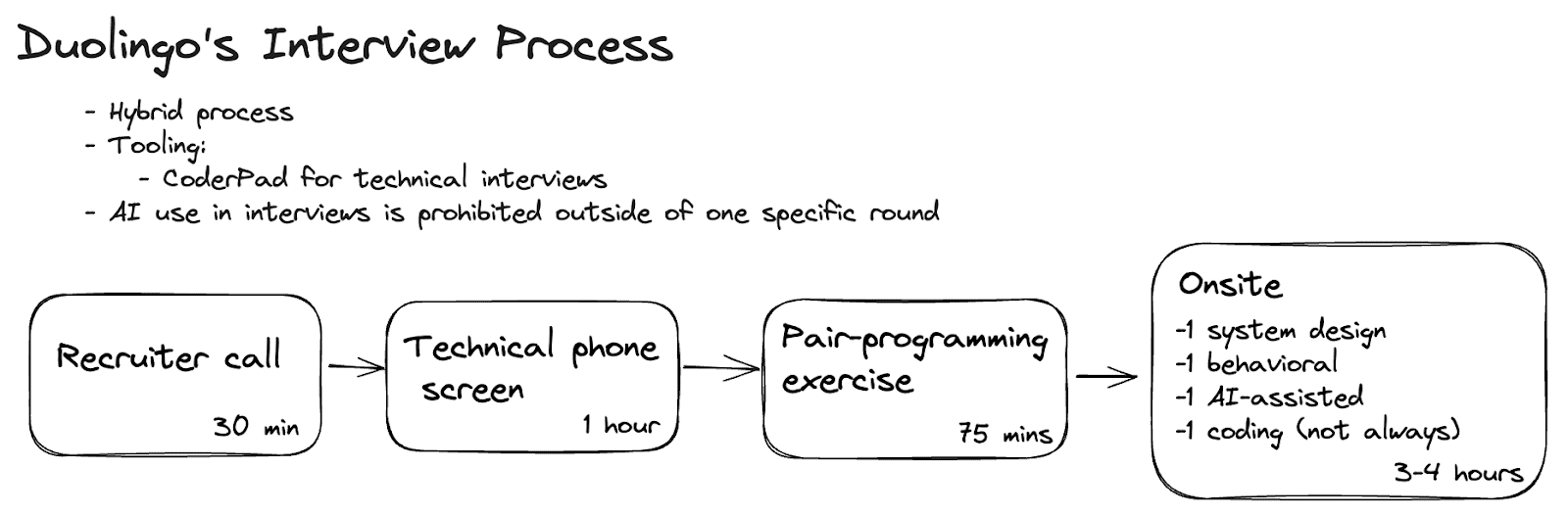
Dropbox has a hybrid hiring process. You interview for a specific role and level, but your interviewers will be from all across the company. There isn't much flexibility to move between different roles during the process, i.e., you're evaluated specifically for the position you applied for. The entire process takes about 4-6 weeks from initial recruiter contact to final decision.
AI Usage
AI use in Dropbox interviews is strictly prohibited during the Onsite rounds, but they require that you use CodeSignal’s AI assistant during the CodeSignal Assessment.
Step 1: Recruiter Call
Dropbox's recruiter call lasts 30 minutes, and it's industry standard: they'll ask you about your previous experience, why you're interested in Dropbox, your understanding of Dropbox's value proposition, and what you're looking for moving forward. They'll also review the specific role you're applying for to make sure you understand the expectations and requirements, and go over the hiring process.
It's really important, at this stage, not to reveal your salary expectations or where you are in the process with other companies. We’ve written a detailed post about salary negotiation that lays out exactly what to say if recruiters pressure you to name the first number.
Step 2: CodeSignal Assessment
Dropbox uses CodeSignal for their technical assessment, which consists of up to 4 questions with a 60-minute time limit. You don't need to complete all questions to pass; completing 3 successfully is typically sufficient to move forward.
The questions are standard algorithmic problems, but not pure LeetCode. They're presented with practical context, making them feel more realistic while still requiring a solid understanding of data structures and algorithms. Expect difficulty levels around LeetCode medium to medium-hard.
As mentioned above, they require that you use Cosmo, CodeSignal’s AI assistant, for this assessment.
Step 3: Onsite Loop - Set 1
Dropbox’s onsite is split into two sets, and you must pass the first set to move on to the second. The first set consists of three interviews, often with two interviewers, one of whom will be shadowing.
- Coding (1 hour). This interview will be conducted in CodeSignal. For more detail about the kinds of questions to expect, see the Coding section below.
- Coding (1 hour). This interview will be conducted in CodeSignal. For more detail about the kinds of questions to expect, see the Coding section below.
- Project deep-dive (1 hour). You'll give them a topic you want to discuss in advance, and they'll bring in an expert in that area. For more detail about what questions to expect, see the Deep-dive section below.
Step 4: Onsite Loop - Set 2
The second set is used primarily for leveling decisions and consists of 2 interviews:
- Behavioral (1 hour). This interview will be conducted by a hiring manager. For more info about what questions to expect, see the Behavioral section below.
- System design (1 hour). For more detail about the kinds of questions to expect, see the System Design section below.
Types of Interview Questions to Expect at Dropbox
Dropbox maintains a very high bar. Having hired for them in the past, we can attest to this. Senior positions there are often expected to perform at a level that would be considered Staff at other companies, and their interviews reflect this. They expect candidates to be proactive, drive solutions, think about edge cases, and communicate problems clearly.
The interviewers are generally helpful throughout the process, but they expect you to take ownership of the conversation and demonstrate strong problem-solving skills. Dropbox values proactive problem-solvers who can think about edge cases and drive solutions forward, so demonstrating these qualities throughout the process is crucial for success.
Dropbox's questions are language-agnostic and are tested internally for fairness and difficulty across different programming languages.
Coding
Dropbox's coding interviews blend practical context with solid computer science fundamentals. While the problems aren't pure LeetCode grinding, you absolutely need to understand data structures and algorithms deeply. Expect questions that are geared towards the product you would be working on.
The questions are a mix of academic and practical, in that they're not solely data structures and algorithms like Meta, but you need to understand the fundamentals. They typically start with a small problem and build progressively, testing your ability to:
- Implement clean, efficient solutions
- Reason about time and space complexity
- Handle edge cases and error conditions
- Communicate your thought process clearly
Expect questions around LeetCode medium to medium-hard difficulty. One variation you might encounter is a round very focused on threading and multi-threading concepts, so be prepared for concurrency questions.
One engineer we spoke to said
It’s a good idea to ask your interviewer if there are more parts (there will be). If you start to struggle with earlier parts you might get cut off, so keep working through the problem but confirm that there are more to come. The questions are designed to be open-ended and you shouldn’t really feel like you are done at any point. Keep working your way through, you will get increasingly challenging questions and they are trying to test you as much as possible.
Below are the technical topics you're likely to encounter in Dropbox interviews. To compile this list, we spoke to engineers who have recently interviewed with Dropbox and cross-referenced with our own data-set of mock interviews.
First, here’s a list of more niche technical topics that are, in our experience, specific to Dropbox:
- Threading/Concurrency
- File System Design
- Content Delivery
- File Metadata Optimization
And here are technical topics that you’re likely to find at other companies as well (for these we’ve created detailed write-ups of their own):
System Design
Dropbox’s system design round is very practical. They will be asking you to build something like one of their own products or a component of it. Think about a file sync API, but consider the entire lifecycle; you may get asked to design one piece e.g., storage or content delivery.
Key tip: Be very cognizant of time management. Don't dive into nitty-gritty details unless the interviewer specifically leads you there. Focus on the high-level architecture first, then drill down based on their interests.
Check out our guide to system design interviews to help you prepare.
Project Deep-dive
You'll give them a topic you want to discuss in advance, and they'll bring in an expert in that area. For example, if you mention payment processing, they'll have someone who understands it in detail interview you. You may also have a shadow interviewer taking notes. This round tests your depth of knowledge in your area of expertise.
The key to success in this round is choosing a topic where you have genuine, deep expertise and can discuss implementation details, architectural decisions, and trade-offs at length. Someone we spoke to who knows the process well said:
I’d advise preparing heavily for this; you’ll be asked about every angle of the project. For senior roles, they’ll be looking for you to have completed a project with full autonomy, unblocking yourself along the way when needed. For L4 and above, you should be displaying an ability to manage multiple projects, priorities, and stakeholders, designing and driving key KPIs with the wider company in mind. You’ll need to discuss tradeoffs, challenges, and how the project achieved the goal you set out.
Behavioral
The behavioral round uses standard "Tell me about a time when..." format questions that work well with the STAR (Situation, Task, Action, Result) method. Expect questions about:
- Leading technical projects
- Handling disagreements with team members
- Dealing with ambiguous requirements
- Times when you had to learn something quickly
- Examples of mentoring or helping others grow
The interviewer will be assessing your leadership potential, communication skills, and cultural fit with Dropbox's collaborative environment.
How Dropbox Makes Hiring Decisions
After all interviews are completed, the panel meets to discuss feedback and make a hire/no-hire decision.
As with other companies, your performance in system design and behavioral rounds can influence whether you're offered an IC4 (Senior) or IC5 (Staff) position.
Interviewers are encouraged to give a strong yes or a strong no. If you get one strong no, you’re done, but one weak no is OK.
See something inaccurate? Please fill out this form, and tell us about it.

About interviewing.io
interviewing.io is a mock interview practice platform. We've hosted over 100K mock interviews, conducted by senior engineers from FAANG & other top companies. We've drawn on data from these interviews to bring you the best interview prep resource on the web.