HubSpot’s Interview Process & Questions
The info below is based on conversations with HubSpot engineers.
HubSpot's Interview Process for Software Engineers: 2-4 Steps
Mid to senior-level engineers interviewing at HubSpot can expect the following process:
- Recruiter call (30 minutes)
- Asynchronous coding challenge (3 hour)
- Onsite (4 hours)
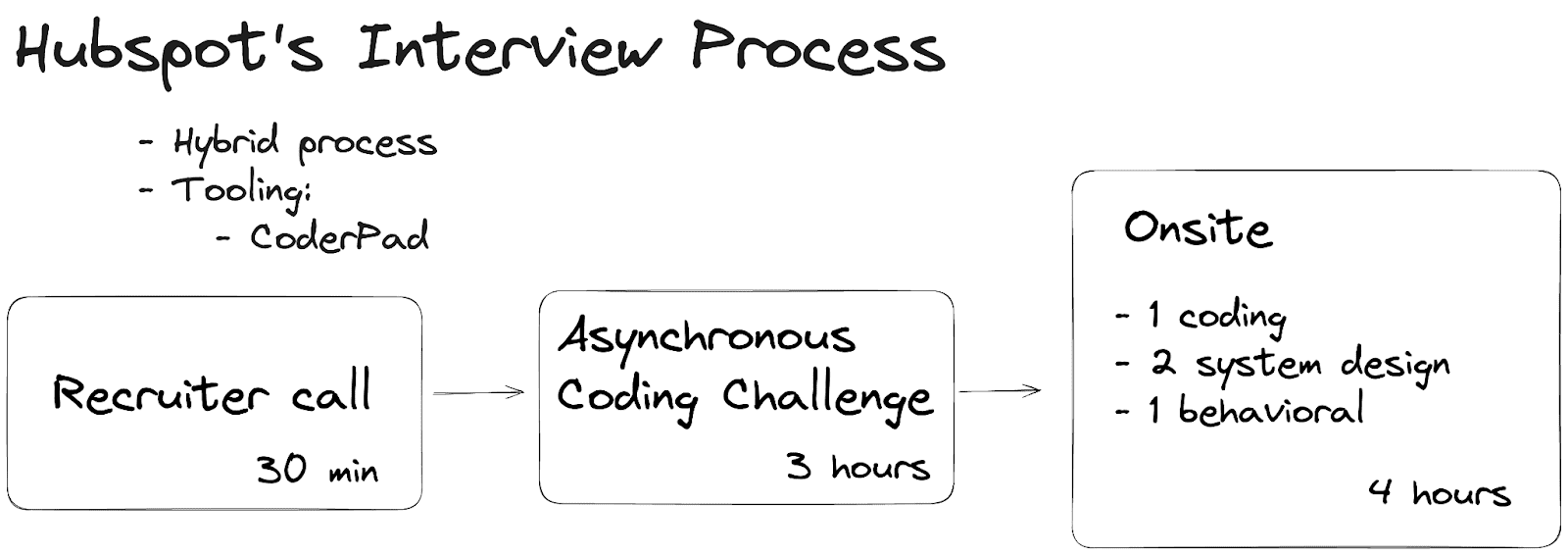
Hubspot’s hiring process is a hybrid. Although you apply for a specific team from the get-go, your interviews will likely not be with the people on your team – interviewers are randomly selected from a pool – except for the hiring manager interview.
Hubspot is one of the few companies that will actually give you some constructive post-interview feedback!
General tips:
- LeetCode practice is helpful, as their coding questions are all in that style.
- During the coding rounds, it is important to find edge cases.
- You might read that they are very focused on the behavioral round and your ability to match up to their values, but in practice we’ve heard their behavioral round is pretty standard. That said, the interviewers will talk about the culture so it’s best to come prepared with questions about their values.
- They use Java, but the interview process is language-agnostic.
- You must convince the interviewer you are familiar with the technologies you mention in a system design interview. You need to know more than buzzwords.
- They know that most of their questions are found online, so they look for you to go deeper.
- You’ll get detailed feedback from the recruiter after the technical onsite rounds. This can be given verbally or via email and will happen before the behavioral round.
The hiring process takes about 2-4 weeks, and we’ve heard that their interviewers are pretty friendly and collaborative compared to FAANG companies. They are also competitive with FAANG salaries.
Step 1: Recruiter Call
HubSpot’s recruiter call lasts 30 minutes, and it’s pretty standard fare – they’ll ask you about your previous experience, why you’re interested in HubSpot, and what you’re looking for moving forward. They will discuss salary ranges, and we’ve heard they are competitive with Meta and Google.
It’s really important, at this stage, to not reveal your salary expectations or where you are in the process with other companies. We’ve written a detailed post about salary negotiation that lays out exactly what to say if recruiters pressure you to name the first number.
Step 2: Asynchronous Coding Challenge
In this challenge, you’ll get API access. You’ll need to make a call to the API, process data, and POST back a response/solution. If the solution is correct, you’ll get a 200 status code, which means you’ve completed the exercise.
You can use any language for this assignment, and it starts as soon as you click the link in the email they will send you. You have three hours to complete the assignment, i.e., make the request to the API. After that, you’ll need to submit the code in a zip file, but that doesn’t need to happen within the three hour window, so you’ll have time to clean up your code afterward.
One engineer we spoke to said:
I don’t think they even review the code, you just need to get 200, and that’s good enough to pass.
Another engineer we spoke to described the problem as follows:
Overall, the pattern is going to be a sorting/aggregating approach to a JSON array, where you have some field like “timestamp”, and some other field that might be an enum, and you will be posting it back to the API provided
Step 3: Onsite
This will vary slightly between Senior SWE 1 and Senior SWE 2 but only during the second system design round. You have to pass each round before moving on to the next.
- Coding (1 hour). This interview will be conducted in CoderPad, but we have heard you can use your own IDE too. For more detail about the kinds of questions to expect, see the Coding section below.
- System design (1 hour). This interview will be conducted in the drawing tool of your choice. For more detail about the kinds of questions to expect, see the System Design section below.
- System design 2 (depending on your level, details are different) (1 hour). For more detail about the kinds of questions to expect, see the System Design section below.
- Behavioral (1 hour). For more info about what questions to expect, see the Behavioral section below.
Types of Interview Questions to Expect at HubSpot
Coding
This will be algorithms and data structures-focused, with LeetCode-style questions. We’ve heard they usually ask LeetCode easy to mediums. While the challenge might seem easy, HubSpot wants you to catch all the edge cases and run tests.
Communication and clarifying questions are things they are looking for. They know their questions can be found online. They expect you have already seen and solved them.
Some examples of the question types they ask are:
- Most repeated substring of size k
- Find the matching string pattern in a given string.
- Find all commonly repeated strings in the 'engineering' string one. How to create an add comma function in js and add it to the global
- Merge two sorted lists up to size k
Below are the technical topics you’re likely to encounter in HubSpot interviews. To compile this list, we did two things. First, we spoke to some current and former HubSpot engineers. Then we cross-referenced all the anecdotes we heard with Glassdoor data AND our own data-set of mock interviews:
System Design
Your first system design round will be very standard. You’ll be asked to design something like Netflix. The main difference between HubSpot and other companies is that they aren’t as obsessed with you mapping out the most optimized solution. It’s more about capturing a broad answer than going deep into one solution.
Your second system design will depend on which role you are interviewing for.
Senior SWE 1 (Equivalent to L4 at other companies)
You will usually be asked to design something like a weather service. One engineer we spoke to described it as being more like application design. The areas you need to consider are:
- Data storage
- Reliability
- Performance
- Horizontal scaling
- Trade-offs
Make sure to ask clarifying questions before you do anything. Their interviewers are collaborative. If you bring up any technologies, you need to know them well as they will drill into them.
Check out our guide to system design interviews to help you prepare.
Senior SWE 2 (Equivalent to L5 at other companies)
This system design round is split into two parts. First, you will be asked to write a document covering a past, technically challenging project and submit it for review They want you to list everything involved from start to finish, including:
- An overview of business problem
- The challenges faced
- The technical implementation
- Any design tradeoffs
- The rollout plan
- The chosen success metrics
- Any lessons learned
They will review your write-up, and, if they like it, you will be invited to another live interview where they will ask you questions about the project.
Behavioral
This interview will be conducted by the hiring manager of the team you are interviewing for. It’s going to be pretty standard, with situational questions. As above, they may talk about the culture at HubSpot so it’s a good idea to come prepared with questions that delve into their values.
How HubSpot Makes Hiring Decisions
Decisions are reached based on your performance in each round. You can still get an offer with one “no-hire”, but your other rounds need to be very strong for this to happen. Hiring managers may still reject candidates in the team matching phase if they see one “no-hire”.
See something inaccurate? Please fill out this form, and tell us about it.

About interviewing.io
interviewing.io is a mock interview practice platform. We've hosted over 100K mock interviews, conducted by senior engineers from FAANG & other top companies. We've drawn on data from these interviews to bring you the best interview prep resource on the web.