SpaceX’s Interview Process & Questions
SpaceX's Interview Process for Software Engineers: 4 Steps
Mid to senior-level engineers interviewing at SpaceX can expect the following process:
- Recruiter call (15 minutes)
- Hiring manager call (1 hour)
- Asynchronous coding assessment (3 hours of work, 2 weeks to complete)
- Onsite (5 hours)
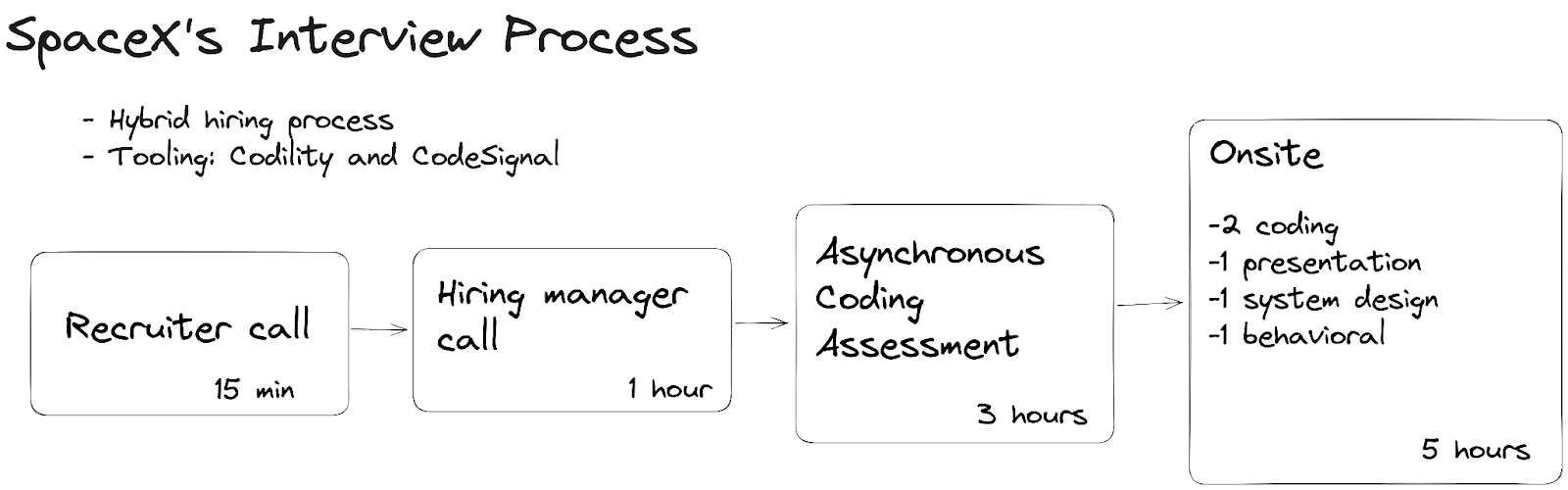
SpaceX has a hybrid hiring process. You apply to a general job posting, and the recruiting team will decide if they want to have a call. After you speak with them, they will shortlist your profile and show it to different hiring managers. If a hiring manager thinks there is a good fit, you’ll move forward to speak with them. If you make it through that call and an offline coding assessment, you’ll head to the onsite phase where you’ll be interviewed by engineers from the hiring manager’s team.
To work at SpaceX you need to be a permanent resident and/or citizen of the United States.
From what we’ve been told, the entire process can take about four weeks.
General advice:
- Go onsite in person. They put a lot of stock in personal relationships, and visiting the site is worth it!
- They don’t need you to get to full solutions, focus on asking the right questions and showing them how you think about the problems.
- LeetCode is helpful for practice, but they are really looking for your ability to solve real-world challenges and pull from your experience.
- Invest a lot of time in the presentation
- Know Elon Musk's 5-step Design Process.
Step 1: Recruiter Call
SpaceX’s recruiter call lasts 15 minutes, and it’s pretty standard fare – they’ll ask you about your previous experience, and why you’re interested in SpaceX
It’s really important, at this stage, to not reveal your salary expectations or where you are in the process with other companies. We’ve written a detailed post about salary negotiation that lays out exactly what to say if recruiters pressure you to name the first number.
Step 2: Hiring Manager Call
This is usually a hybrid call, with some questions about your experience and some technical questions. As the hiring manager has picked your profile from a shortlist, they will have seen something in your background that they want to delve into. After that, you might get a system design question that relates to your previous work or the team you are interviewing with.
Step 3: Asynchronous Coding Assessment
This assessment should take you 3 hours, but you have 2 weeks to complete it. It takes place on Codility. Expect medium-level LeetCode questions that you can find online but with slightly different descriptions.
Step 4: Onsite
The onsite can be virtual or on-location. As above, try to actually go onsite if possible. Seeing the rockets alone is worth it but, they also like to meet people in person. You’ll get an additional 45 mins to have lunch with the recruiter. This is a great time to ask good questions and build rapport.
- Facility tour (if in person, 25 mins) The recruiter will walk you around the site.
- Prepared project/source code presentation (1 hour). You’ll be asked to suggest five ideas ahead of time, and they’ll pick the one they’d like you to present in person. The presentation will be in front of the entire team. This is a really important step in the process. You’ll be asked to present your project and some of the source code (if possible), and they will ask lots of questions throughout your presentation. Keep Elon Musk’s 5-step Design Process in mind here. They look for simplicity in your approach.
- Coding (1 hour). This will likely be in CodeSignal. There might be some design elements here in addition to coding, and it will usually relate to SpaceX. For more detail about the kinds of questions to expect, see the Coding section below.
- Lunch (if onsite, 45 mins) This will be with the recruiter and is a great time for you to ask good questions.
- Second Coding (1 hour). This will likely be in CodeSignal and is usually conducted by two interviewers. For more detail about the kinds of questions to expect, see the Coding section below.
- System design (1 hour) For more detail about the kinds of questions to expect, see the System Design section below.
- Behavioral (1 hour) This interview is with the hiring manager. For more detail about the kinds of questions to expect, see the Behavioral section below.
Types of Interview Questions to Expect at SpaceX
Coding
Don’t expect LeetCode-style questions at the onsite stage. Instead, you’ll see hybrid questions that have an algorithmic component, a coding component, and a design component. SpaceX likes to ask questions that make you think and draw on previous experience. A lot of their coding questions will bear some relation to real-world SpaceX problems. Talk through your approach, as it’s more important to show how you think than to reach a full solution.
From one of our users who recently went through SpaceX interviews:
The coding portion was more about normal logic and problem-solving design questions which did not require deep algorithmic knowledge: more about understanding the problem, asking the right questions, and providing SIMPLE and scalable design.
A sample question might focus on spare parts for rockets and how to keep track of them as they move in and out of refrigeration. You may have to write code that tracks and logs the time each spare part is out, for instance.
Below are the technical topics you’re likely to encounter in SpaceX interviews. To compile this list, we did two things. First, we spoke to some current and former SpaceX engineers. Then we cross-referenced all the anecdotes we heard with Glassdoor data AND our own data-set of mock interviews:
Outside of the topics above, you may see questions about data hazards, memory management, and generally questions that get at your understanding of how programming works under the hood (e.g., compilers).
System Design
Here you will likely be presented with a relatively straightforward design task but not given many details. For instance, you might be asked to design an inventory management system that involves multiple locations and items, similar to the example in the coding section above, except that in this interview, you’ll be focusing more on the design and less on the coding parts. In the inventory management system question, you’ll have to:
- Design database tables for managing spare part inventory
- Think about how to handle movement and transfers of items
- Discuss how you would do this at scale.
Note that these questions will intentionally sound simple, and your interviewer will not provide a lot of details – they’re looking to see how you deal with ambiguity and how you ask questions to fill in the blanks.
Check out our guide to system design interviews to help you prepare.
Behavioral
The behavioral interview is another critical step in the process. It’s possible that you perform well in this interview but poorly in one or more coding sessions yet remain in the process. If that happens’ you’ll likely be asked to do another coding interview.
Expect to encounter similar questions to the Amazon Leadership Principles type of interview during this round.
One engineer we spoke to also said they were asked how they felt about working with Product Managers. They told SpaceX it wasn’t always necessary to work with one and the interviewer seemed happy. It’s possible they do not have PMs.
How SpaceX Makes Hiring Decisions
Decisions are at the hiring manager's discretion but they look for consensus. If you fail a round you might be asked to complete an additional interview. For example, if you fail one of the coding rounds, you might get another to complete.
See something inaccurate? Please fill out this form, and tell us about it.

About interviewing.io
interviewing.io is a mock interview practice platform. We've hosted over 100K mock interviews, conducted by senior engineers from FAANG & other top companies. We've drawn on data from these interviews to bring you the best interview prep resource on the web.