Adobe’s Interview Process & Questions
The info below is based on conversations with Adobe engineers.
Adobe's Interview Process for Software Engineers: 4-5 Steps
Mid to senior-level engineers interviewing at Adobe can expect the following process:
- Resume screen (1-2 weeks)
- Online assessment - if required (60-90 minutes)
- Recruiter call (30-45 minutes)
- Hiring manager screen (45-60 minutes)
- Virtual onsite (3-5 hours)
General tips:
- Referrals significantly increase your chances of getting to the phone screen.
- Adobe values clean, optimized code. You can miss an edge case and still pass the round if your code is well-structured and you explain your thinking.
- When discussing past projects, connect your technical decisions to problems Adobe solves (e.g., document rendering, creative tooling, cloud scale). Interviewers respond well to candidates who've thought about the domain.
- For system design rounds, Adobe lets you use a drawing tool of your choice. Pick one you're comfortable with beforehand (most candidates use Excalidraw or Miro), so you're not fumbling during the interview.
Adobe's hiring process is hybrid. Centralized recruiting handles screening and logistics, but the interview experience and team matching vary significantly depending on the product team. The average timeline is 3-6 weeks from application to offer.
AI Usage
AI use in Adobe interviews is not currently permitted.
Step 1: Online Assessment (OA)
Not all candidates receive an OA. It depends on your role and background. For technical roles, the assessment is coding-focused: expect 2–3 algorithm and data structure problems at around LeetCode medium difficulty, to be completed within 60–90 minutes.
Step 2: Recruiter Phone Screen
Adobe's recruiter call lasts 30-45 minutes and is mostly logistical. You'll discuss your background, the role and team, your availability, and occasionally, your compensation expectations.
It's really important, at this stage, not to reveal your salary expectations or where you are in the process with other companies. We’ve written a detailed post about salary negotiation that lays out exactly what to say if recruiters pressure you to name the first number.
Step 3: Hiring Manager Screen
The hiring manager (HM) screen lasts 45-60 minutes and typically includes a discussion of your background and projects, a technical deep dive into your experience, and culture fit and team alignment questions. Occasionally, you'll get a light coding problem or technical scenario, too.
The goal is for the hiring manager to answer two questions:
- Can this person do the job technically?
- Will this person thrive on my team?
As a senior engineer at Adobe put it:
"The goal here at Adobe is to understand how you think about problems, how you approach ambiguity, and whether you'd mesh well with the team day-to-day."
Step 4: Take-Home Coding Challenge
Some Adobe teams assign a take-home coding challenge after the recruiter screen or hiring manager interview, separate from the online assessment. If assigned, you'll typically have 3-7 days to complete it (the actual coding takes 2-4 hours). After you submit it, one of your virtual onsite rounds will be dedicated to walking through your solution with an engineer. If you submitted a coding challenge earlier, Adobe will have you walk through it with an engineer. What they're evaluating:
- Did you actually write this code?
- Can you explain your decisions?
- How do you respond to criticism?
- Can you debug your own code?
- How do you handle unexpected requirements?
It’s a good idea to write your take-home code like production code that will be reviewed. This means using descriptive variable names, commenting complex logic, organizing code into clear functions, and handling edge cases and errors.
If your code is poorly structured or has obvious bugs, the interviewer will spend the session pointing out issues rather than letting you demonstrate your technical thinking. Clean code lets you focus on explaining your approach instead of defending basic implementation choices.
Step 5: Virtual Onsite
The virtual onsite consists of 3-5 rounds of 45-60 minutes each, conducted back-to-back or over a couple of days.
For mid-level and senior engineers, expect:
- 2-3 data structures & algorithms (DSA) rounds (45-60 mins each) conducted in CoderPad. For more detail about the kinds of questions to expect, see the Coding section below.
- 1 system design round (45-60 mins). Adobe lets you use any drawing tool, though most candidates go with Excalidraw or Miro. For more detail, see the System Design section below.
- 1 low-level design / OOD round (45-60 mins), also conducted in CoderPad. For more detail, see the Coding section below.
- 1 behavioral / leadership or domain-specific round (45-60 mins). For more detail, see the Behavioral section below.
For staff+ engineers, expect:
- 1-2 DSA rounds (45-60 mins each) conducted in CoderPad. For more detail, see the Coding section below.
- 2 system design rounds (45-60 mins each). As above, Excalidraw and Miro are the common choices. For more detail, see the System Design section below.
- 1 low-level design round (45-60 mins), conducted in CoderPad. For more detail, see the Coding section below.
- 1 behavioral / leadership round (45-60 mins). For more detail, see the Behavioral section below.
The same senior software engineer at Adobe described their own onsite: "in my Adobe interview, I had only one round of DSA and three rounds of LLD and one round of HLD. At my level, system design matters a lot more than DSA. But at entry level, it's DSA, DSA, only DSA."
If you completed a take-home (see Optional Step above), one of the above rounds will be a walkthrough of your submission.
Types of Interview Questions to Expect at Adobe
Coding
Adobe's DSA interviews prioritize clean, optimized code over brute-force solutions that pass every test case. According to a senior engineer who interviewed there:
"Adobe will say write optimized code and clean code. If out of 10, seven test cases are passed and you write clean and optimized code, you're good to go. You've cracked that interview."
The intensity varies by team. Backend roles tend to run 2-3 LC rounds with medium-to-hard questions, while frontend teams generally run fewer algorithmic rounds and lean toward role-specific problems. Either way, expect to be asked a follow-up on the same problem after you solve it (a harder variant or an edge case extension), so don't treat a working solution as the finish line.
Adobe focuses on fundamental data structures used in its products, so expect questions on topics that are directly relevant to file systems, rendering engines, and document structures.
Here are a few real DSA question examples you can learn from:
- Given a list of absolute file paths, implement insertPath and pathExists operations efficiently.
- Given a string, return the minimum number of edits (insert, remove, replace) required to convert it into another string.
Another detail worth adding is that Adobe doesn’t expect flawless code.
In my second coding round, I missed a few edge cases and couldn't write a fully working solution. I walked out of there thinking I’d be booted but still got the offer. After my coding problem, the interviewer simply pivoted to OOP and distributed systems questions. Which was much better for me.
Below are the technical topics you're likely to encounter in Adobe interviews. To compile this list, we spoke to some Adobe engineers and cross-referenced their input with Glassdoor data and our own data-set of mock interviews:
- https://interviewing.io/binary-trees-interview-questions
- https://interviewing.io/trees-interview-questions
- https://interviewing.io/linked-lists-interview-questions
- https://interviewing.io/sliding-window-interview-questions
- https://interviewing.io/mapreduce-interview-questions
- https://interviewing.io/binary-search-interview-questions
- https://interviewing.io/arrays-interview-questions
- https://interviewing.io/strings-interview-questions
- https://interviewing.io/graphs-interview-questions
- https://interviewing.io/queue-interview-questions
- https://interviewing.io/depth-first-search-interview-questions
System Design
System design interviews involve working through a problem close to Adobe's actual products. The goal here is to reveal how you think at scale. The conversation usually moves through the same arc:
- Clarifying the requirements
- Sketching a workable design
- Zooming into one or two components
- Pressure-testing how your system behaves under load or failure
"The system design problem involves gathering requirements, coming up with a high-level diagram, and database design. In my case, for example, I got a small LLD problem of a booking app. Typical classes for Order creation to Order Execution flow. But the real focus was on how I applied good design principles. All this was in the space of an hour, by the way."
For tooling in system design interviews, Adobe allows you to choose any type of drawing tool. The common choices among candidates are Excalidraw and Miro.
Check out our guide to system design interviews to help you prepare.
Behavioral
The process is typically conversational. Our sources say there’s usually a "fit check". These are discussions on previous research and project experience, with emphasis on explaining your contributions and how they connect to Adobe's work.
Here are some of the questions senior role candidates were asked in the behavioral interview sessions:
- Can you share an example of a time when you took initiative to improve a process or solve a problem at work?
- How do you deal with a manager who is highly technical but has a very low score in team engagement?
- How will you deliver a project with 3 resources in 3 months, while the initial estimate is 9 months, 9 resources?
- What are Adobe's future big bets, and how will you help with them?
How Adobe Makes Hiring Decisions
After the onsite:
- Debrief meeting (1-3 days after): Interviewers meet to discuss your performance and reach a hiring decision
- Recruiter follow-up (1-2 weeks): You'll receive a call or email with the decision
- Offer or rejection: If rejected, you can typically reapply in 6-12 months
We've heard that the process can take a while.
"I had to wait 2 weeks and follow up multiple times to get the result. Feels kind of frustrating that you can spend 8+ hours and not receive any email, even if it's a rejection."
See something inaccurate? Please fill out this form, and tell us about it.
About interviewing.io
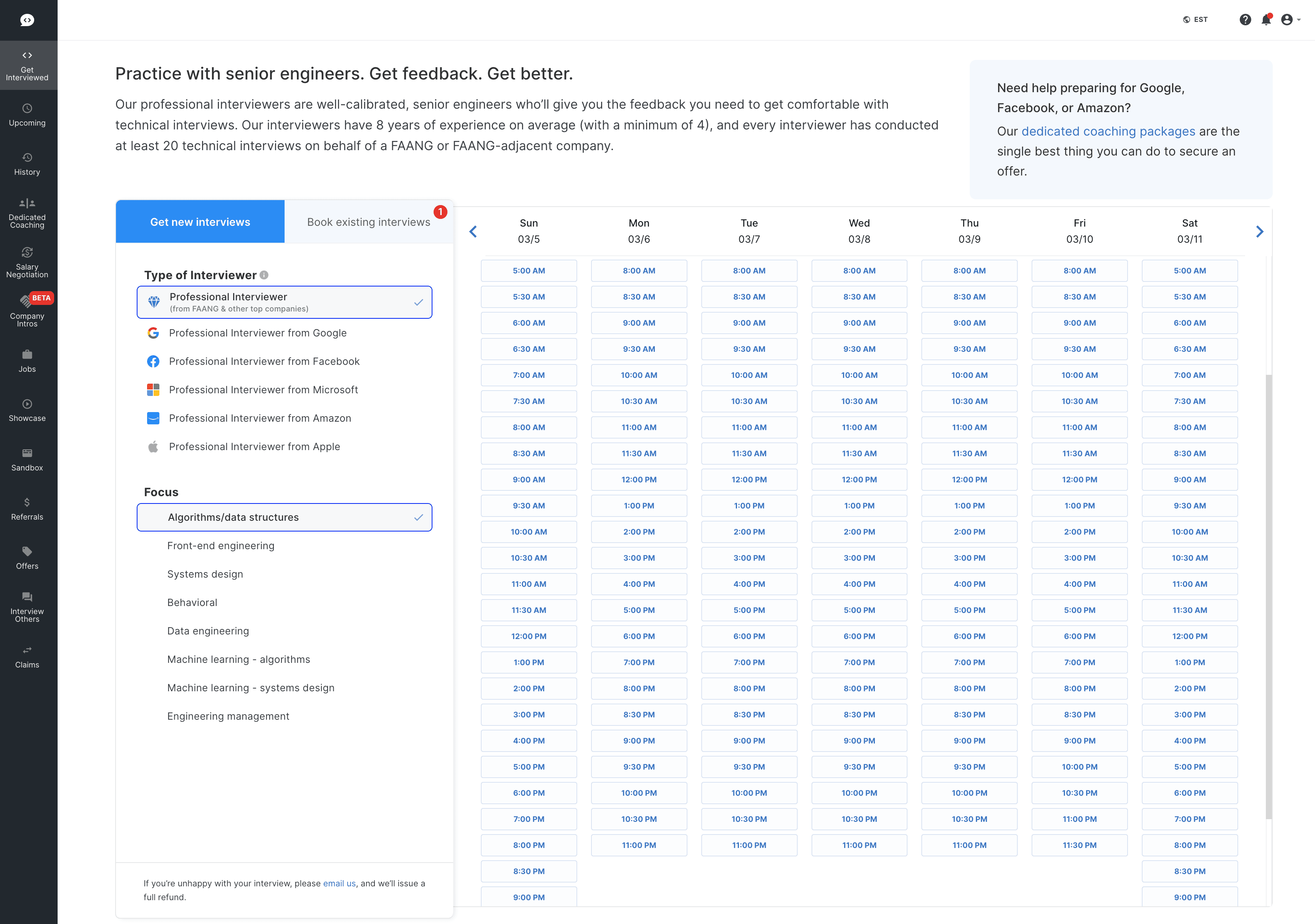
interviewing.io is a mock interview practice platform. We've hosted over 100K mock interviews, conducted by senior engineers from FAANG & other top companies. We've drawn on data from these interviews to bring you the best interview prep resource on the web.
See something inaccurate? Please fill out this form, and tell us about it.

About interviewing.io
interviewing.io is a mock interview practice platform. We've hosted over 100K mock interviews, conducted by senior engineers from FAANG & other top companies. We've drawn on data from these interviews to bring you the best interview prep resource on the web.