User Story: Jamie White, MIT alum and engineering manager at Roblox
Hey, Aline (founder of interviewing.io) here. This is the inaugural post in our new User Stories series.
One of the biggest misconceptions about technical interview practice is that it's just for students. However, our data tells a different story. Experienced engineers are 25% less likely than new grads to pass their first mock interviews, according to our data. Moreover, in the current market, where the bar has consistently gone up since the downturn, practice matters more than ever. You don't have to practice with us, but you should practice... and don't forget system design — a lackluster performance in those interviews is one of the main reason people get down-leveled.
My heartfelt thanks to my friend Jamie White for sharing his story (including two replays of failed mock interviews) and for coming to us for his prep in the first place. If you'd like to share your story on our blog, we’d love to hear from you. Please email me at aline@interviewing.io.

Jamie is a two-time founder and perennial engineer. His work has spanned medical devices (Common Sensing + MIT), photon detectors (MIT), and labor unions (Unit of Work). Most recently, he’s been working on creativity tools at Roblox, where he’s an engineering manager. Jamie likes tech but loves humans, spending weekends playing video games with friends and organizing queer community events. You can find him on Twitter and LinkedIn.
Right out of grad school, my friend and I started a company. I originally said I'd be there for a year or two and then go get my PhD. Seven years later, I left that company to start another. After three years, I shut the second company down and was deciding what to do next. The largest team I'd ever had at that point was around 30 people (including part-time + contractors). I was ready for a new experience–a larger team, more financial security, the chance to dive deeper into technical topics. I decided I wanted to be a principal software engineer, and not for a 30-person startup. In the search for this experience, I found the Big Tech Interview.
I had interviewed many people by this point, but none of the companies I ran had emulated the Big Tech Interview. I was completely new to it. The first super-important thing I learned is just because you're qualified for the job, doesn't mean you can pass the Big Tech Interview. I'm really smart. I got a 4.9 GPA at MIT. By this time I had worked with a pretty wide range of different software languages, tools, frameworks, ideologies, etc. I had managed 30+ people and could also plan and build complex systems solo when needed. I felt very qualified for the positions I was applying for. On my first Big Tech Interview, I did terribly.
Luckily, it wasn't high on my list. I took advice from a brilliant friend and applied to my least favorite job first. The interview began. I'm a great communicator, breaking the ice and getting started was easy. I asked a few questions and got started, but I was already doomed. I hadn't written code in plain-text in ages. I missed some basic questions you should always ask. I didn't properly consider my edge cases. I forgot what a heap sort was, and there wasn't enough time to Google. My timing was off, and I wasn't sure how much I should talk vs code vs test. Didn't get the job.
An internal recruiter at a separate company had faith in me and gave me some great advice: "Our interviews are really hard; you should go online and practice before you move on to that stage - I'll wait". This is when it clicked. The Big Tech Interview has a meta: video game lingo for a strategy that is agreed on by the community to be most effective.
Not only do Big Tech Interviews have a meta, but because in this hiring game you are competing against other candidates, not learning that meta puts you at a huge disadvantage, even if you're a great match for the job. I called around my friends who had been hired by Big Tech companies or hired for them, asking how to play the game most effectively. One particular friend blew my mind with how much she knew about Big Tech hiring, including the interview meta: Aline Lerner. Aline founded a company–interviewing.io–to help people like me. Because I'm such an awesome friend, I got started for free, although I ultimately also paid instead of begging Aline for more freebies. It was that good.
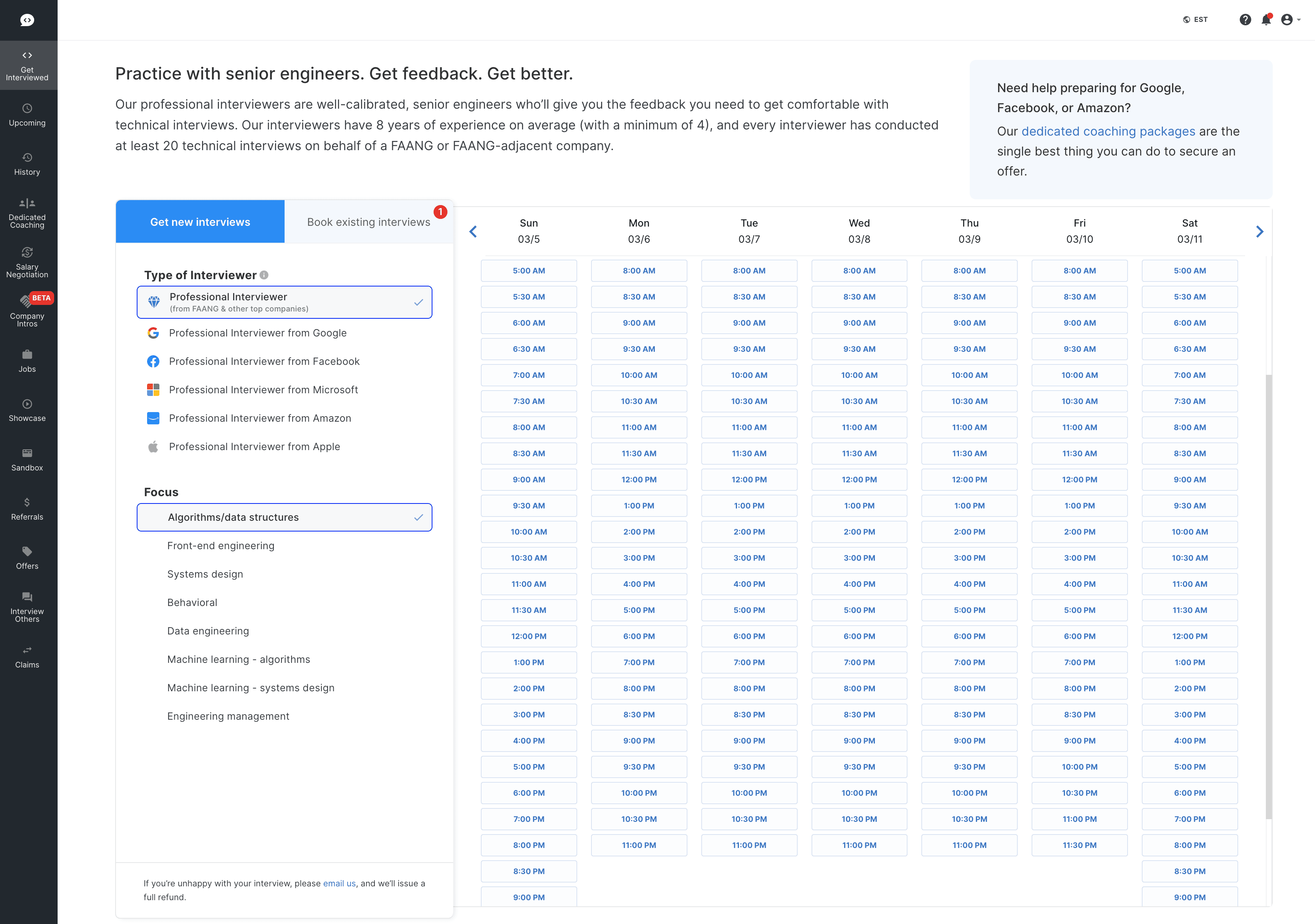
Aline led me to the two key features at interviewing.io that would ultimately prevent me from bombing again: practice interviews and recorded interviews. Practice interviews pair you with someone who actually interviews for a Big Tech company at the level you're shooting for. You enter a blind, simulated remote interviewing environment. You can set the collaborative editor to plain-text or one of many programming languages. A diagramming whiteboard mimics similar tools that companies provide during their interviews. After a brief introduction, the interviewer asks if there is anything particular you want to focus on, and then for the next hour you are in a very realistic-feeling Big Tech Interview. I found these interviews to be slightly harder than the real-life ones, a great direction to err. When time is up, your interviewer transitions to giving immediate feedback and tips, all of which are added to an overall dashboard for the interview, along with a single rating from 1-4.
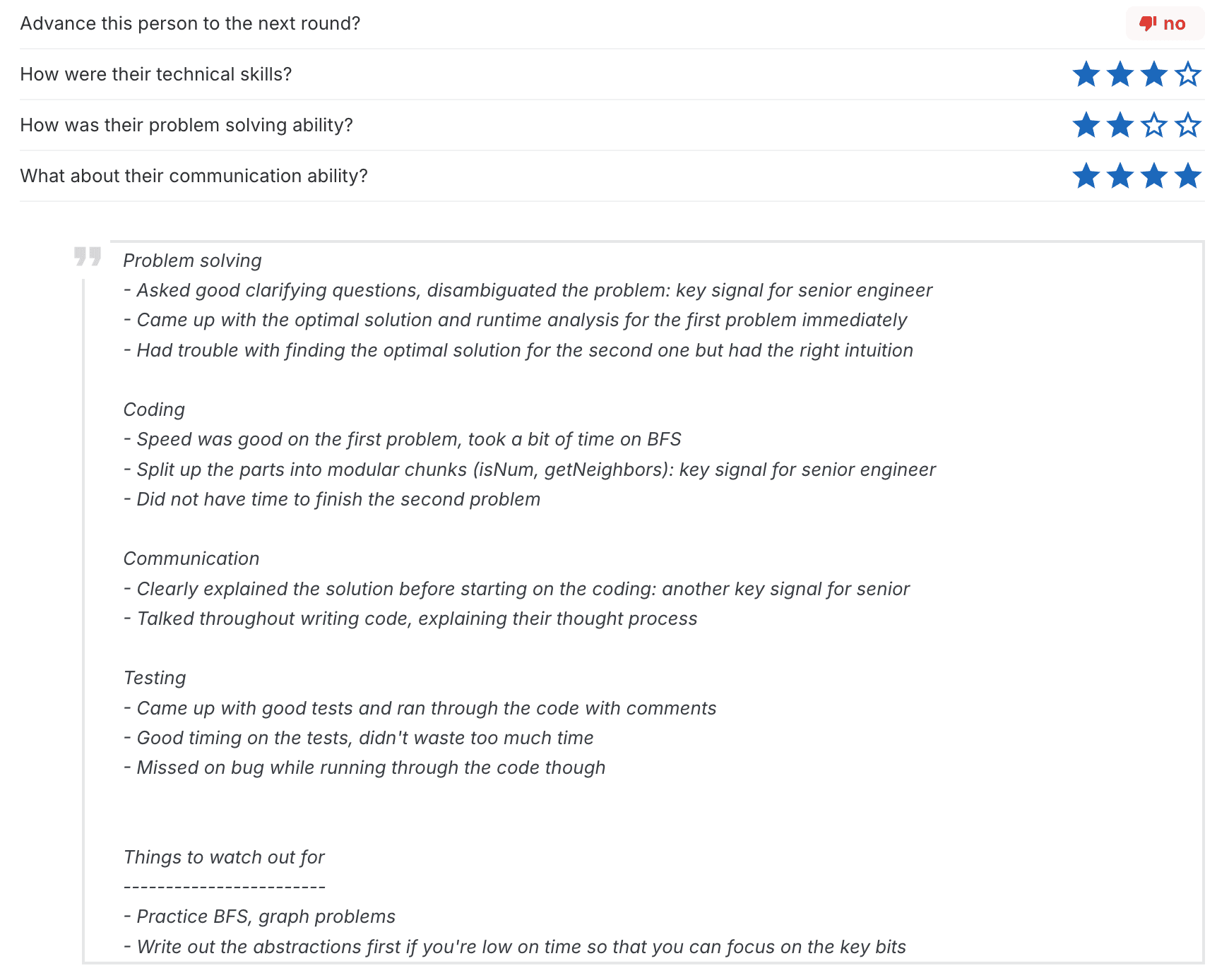
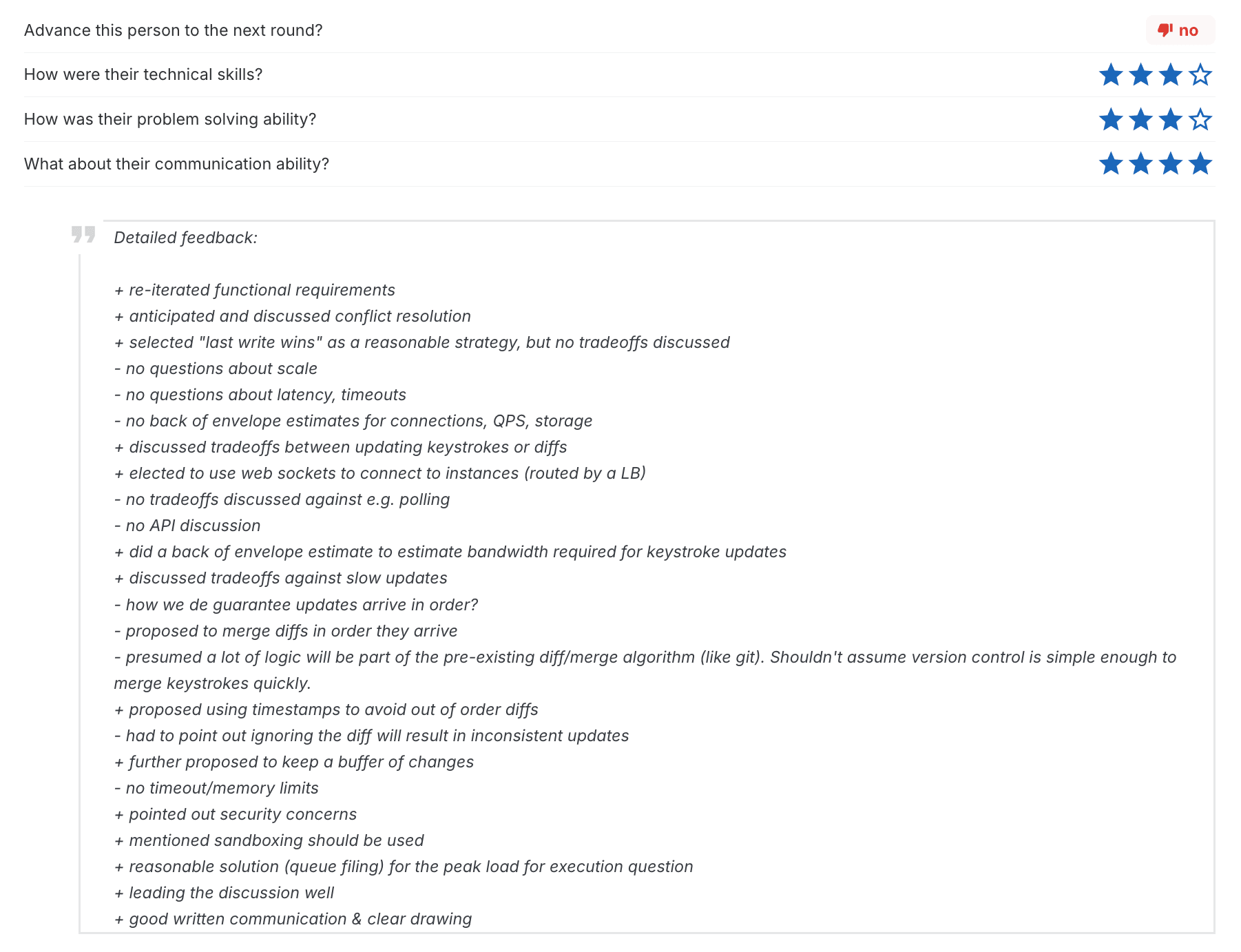
Here are a few of my early failed interviews. You can watch them if you want, too. The first one is algorithmic, and the second interview is system design. Huge thank you to Jamie’s excellent interviewers in these interviews, Continuous Hedgehog (algorithmic) and Indelible Hawk (system design), for their willingness to share these as well.
Algorithmic interview
System design interview
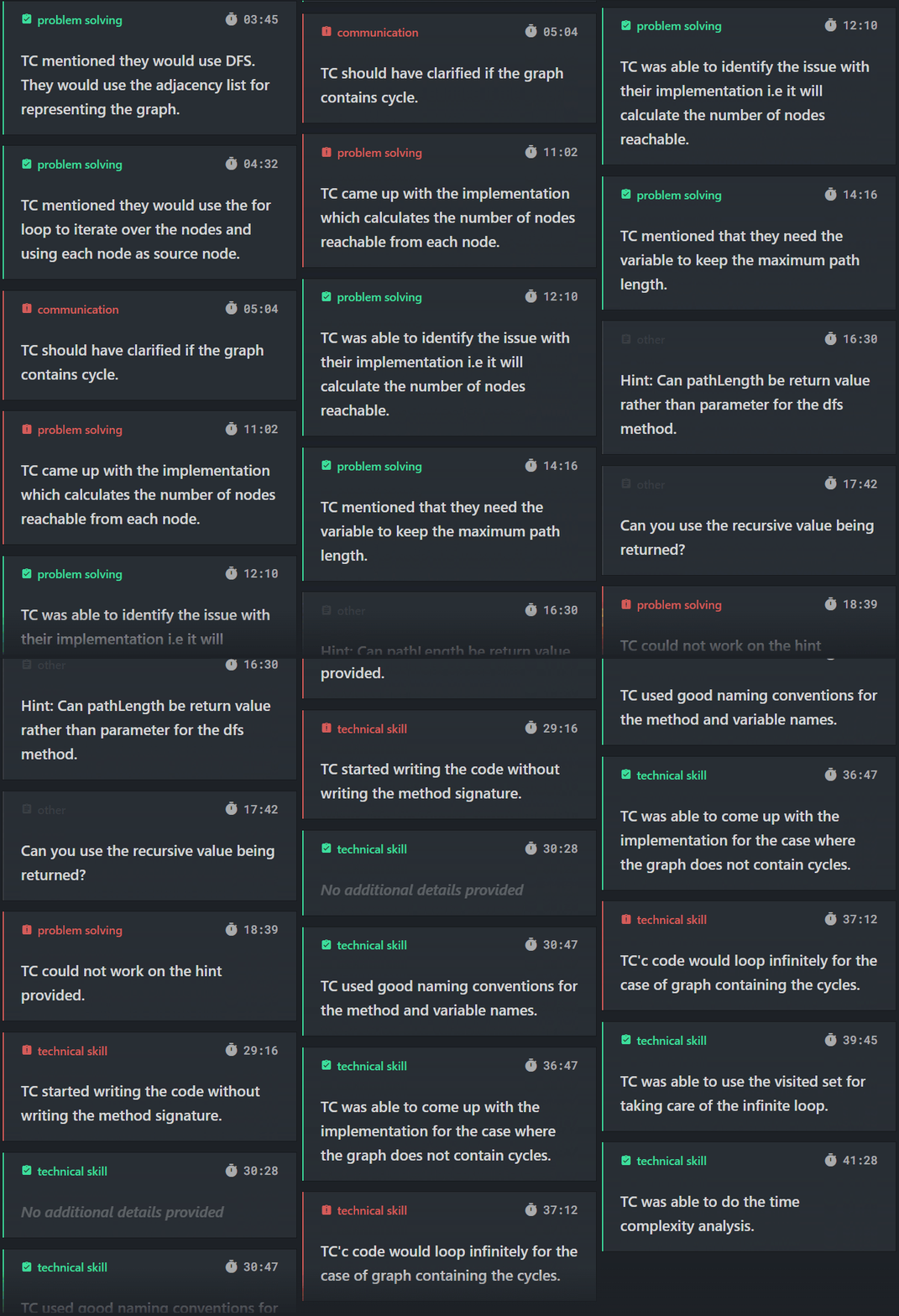
Once finished, you can revisit that interview any time you want through the interview recording. The recording not only includes synced-up audio, code, and diagramming but also includes a secret notes panel where your interviewer is jotting down their thoughts in real-time.
When an interview is complete, you have the option to opt-in and publish your anonymous interview for all interviewing.io users to see. After Aline showed me this feature, I was hooked. I would pull up interviewing.io’s replay showcase and watch an interview over lunch, listen to one in the background while I worked out, or deep-dive into one, pausing to attempt answering myself first.
Over about 10 live and 20 recorded interviews, I could see my ratings progressing upward. Weak spots became apparent, and I focused on them. I was grokking the meta, and I reached out to the recruiter to go forward with the tech interview. I did one more live practice session the day before the real interview I was warned about.
I aced it. I still had nerves; I don’t think you can necessarily rid yourself of those. And the problems were novel to me. I hadn’t encountered them specifically in my practice. But thanks to my mock interviews, I was able to quickly understand and solve these coding/systems problems, which meant my interviewer and I could move on to more advanced topics and talk about my work instead of traversing binary trees. This also gave me time to learn more about the company and interviewer and have some fun, albeit nerve-wracking fun.
Ultimately, I got amazing offers, including from the recruiter who gave me that warning. All noted that my interview performance was high. If I had walked in and performed like my first ill-advised interview above, I would have had to settle lower down my list.
If you've been reading, you won't be surprised at the takeaway here. No matter how good at the job you are, you need to practice for the Big Tech Interview meta. interviewing.io was instrumental in getting me there, and I recommend them to everyone now. You'll be giving your job ~2000 hours of your time every year; it's totally worth the time and money to make sure you end up where you want.

Related posts
Have interviews coming up? Study up on common questions and topics.
We know exactly what to do and say to get the company, title, and salary you want.
Interview prep and job hunting are chaos and pain. We can help. Really.